The Golden Hour on the Last Tube: Mark McEvoy’s Ode to 1990s London Nights
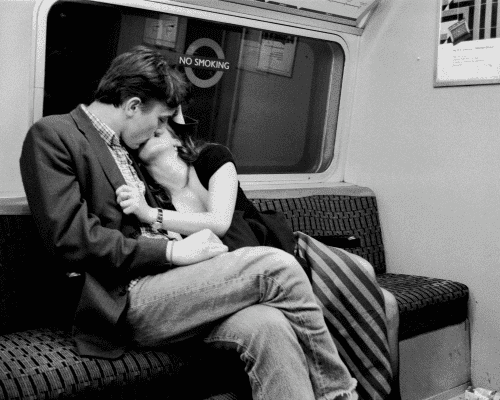
There is a moment, just after the pub doors swing shut and before the night truly begins, when London’s arteries pulse with possibility. It is 11pm on a Friday, and the tube carriage is a velvet box of strangers — a barrister loosening his tie, a raver still humming with bass, a couple stealing a first kiss against the rattling doors. Mark McEvoy saw this scene and recognized it for what it was: not a commute, but a theatre of human connection. Between 1992 and 1995, he rode the last trains out of central London, camera in hand, and documented the golden hours of the week — those fragile, giddy intervals when friendships are forged, lovers meet, and the city exhales.
McEvoy wasn’t a detached observer. He was, by his own admission, a Camden Town bohemian — “slightly hippy-ish, trendy, kind of casual, into funk, jazz and reggae” — who smoked a lot of weed and lived for the night. One evening, returning from Brixton, he was struck by the carriage’s accidental choreography: a mix of ages, races, sexualities, and subcultures, all swaying together in a shared, unspoken truce. “We’ve all been there,” he says. “We can straight away relate to that space.” That epiphany turned into a two-year project, shooting on Friday and Saturday nights around traditional closing time, when the last trains became a rolling salon of London’s finest hours.
The photographs are remarkable for their lack of artifice. McEvoy used a compact 35mm camera, often with a flash, but the images feel less like staged portraits than like frames from a memory. There’s the couple mid-argument, the group of mates howling with laughter, the lone woman with a faraway gaze — all rendered in the grainy, high-contrast glow of film that has since become the visual shorthand for 1990s cool. These aren’t the glossy, curated faces of fashion magazines; they are the tired, happy, thoughtful faces of people who have just made a friend, lost a heart, or decided to take a chance. The carriage, with its fluorescent hum and vinyl seats, becomes a stage for the most significant moments of our lives — the ones that seem frivolous at the time but shape who we become.
For collectors, McEvoy’s work offers something rarer than a print: it offers a time capsule. The 1990s London tube was a pre-digital frontier, where conversations were unmediated by screens and the last train was a race against the clock. The Night Tube, which began on some lines a decade ago this month, has softened that urgency — but it has also, in a way, diluted the magic. McEvoy’s images, now sought after by galleries and private collectors of social documentary, preserve a moment when the city’s nightlife was a choreographed dance of chance. They sit alongside the works of figures like Martin Parr and Nan Goldin, who also captured the raw, unvarnished texture of everyday life — but McEvoy’s focus on the tube makes it uniquely intimate, a shared space that every Londoner has inhabited.
What makes these photographs so compelling in the context of luxury taste is their honesty. The ultra-wealthy often curate their lives around the exceptional — the rare vintage, the one-of-a-kind supercar, the private island. But McEvoy reminds us that the most precious commodity is often the unguarded moment. His work speaks to a growing desire among collectors for authenticity, for objects that carry the weight of real human experience rather than the polish of a showroom. It’s no coincidence that his images resonate with the same emotional frequency as a perfectly worn leather jacket or a first-edition Patti Smith memoir — they are artifacts of a time when life was lived in public, without filters, and that rawness has become the ultimate luxury.
Looking at McEvoy’s photographs today, one feels a pang of nostalgia for a London that has since been gentrified, sanitized, and digitized. The night tube may have extended the party, but it also killed the panic — and with it, the exquisite tension of that last-chance scramble. McEvoy’s work stands as a loving eulogy to that tension, and a reminder that the best moments are often the ones we almost missed. For those who collect stories, not just things, his images are a rare find — a window into a world that was always fleeting, but never forgotten.