The New Golden Generation: Why Australia’s Young Footballers Are the Ultimate Luxury Asset
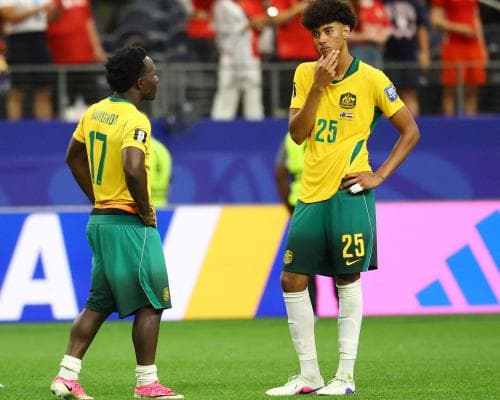
There is a particular thrill in watching a young talent step off a plane into a new life, especially when the destination is Lisbon and the greeting party is a scrum of local journalists asking about dance moves. Nestory Irankunda, all of 20, grinned and confirmed that yes, he plans to unveil a Michael Jackson-inspired celebration at Sporting. It was a moment of pure, unscripted charm—the kind that makes you forget, for a second, that this kid is also a multimillion-dollar investment. But make no mistake: this is the business of beautiful things, and Australia is suddenly producing some of the most coveted assets in world football.
Irankunda’s transfer to Sporting from Watford, reportedly worth around $25 million plus add-ons, is not just a career move. It is a statement. Sporting is a club that knows how to polish raw diamonds—think Cristiano Ronaldo, Luis Figo, and a conveyor belt of Portuguese talent that has made the Lisbon club a byword for elegant, attacking football. For Irankunda, who scored for Australia against Turkey at the World Cup and then showed flashes of brilliance in a substitute role against the USA, this is the step from promising prospect to genuine contender. He will trade the gritty grind of the Championship for Champions League nights under the lights, wearing green and white, with the eyes of Europe upon him. As his Socceroos teammate and mentor Awer Mabil put it, “It’s a very good move for him. It’s a perfect club also for him to take that next step, and then from there on he will make a bigger step for sure.” That is the language of connoisseurs—knowing exactly when to buy, and when to hold.
Meanwhile, Lucas Herrington, just 18, is poised to break the Australian transfer record. His move to Premier League returnees Hull City from Colorado Rapids could eclipse the $38.3 million Leicester paid Stoke for Harry Souttar in 2023. That is a staggering figure for a teenager, but Herrington has the rare combination of composure and audacity that clubs pay a premium for. He will be thrown into the deep end, helping a club fight for Premier League survival, which is both a baptism of fire and a masterclass in pressure. The transfer vortex that follows every World Cup has swept these two into its orbit, and the timing is impeccable: the Asian Cup in Saudi Arabia in January looms as the next major test for the Socceroos, and these young guns will arrive with new scars, new confidence, and new swagger.
What makes these moves so fascinating is not just the money—though $25 million and a record-breaking fee are nothing to sneeze at—but the craftsmanship behind the development. Irankunda’s path has been anything but linear: brief stints in Germany and Switzerland, a promising if inconsistent year at Watford, and then a World Cup where he was asked to play central striker as Australia were eliminated in the round of 32. That kind of adversity is the grit that polishes a gem. Herrington, too, has been shaped by the American system, which is increasingly a fertile ground for technical, fearless players. The Socceroos have quietly built a pipeline that rivals the best academies in Europe, and these two are the proof in the pudding.
For collectors of sporting talent—and let’s be honest, that is what top clubs are—the market is all about timing and provenance. Irankunda arrives at Sporting with a highlight reel that includes a goal against Turkey and a growing reputation as a winger who can also lead the line. Herrington, at 18, is already a starter for a Premier League club, which is more than most players twice his age can claim. The transfer fees reflect not just current ability, but future potential, and the market is betting big. For the ultra-wealthy who follow football as a passion and an investment, this is the equivalent of buying a blue-chip painting before the artist’s retrospective—except these assets run, dribble, and occasionally moonwalk.
What does this signal about luxury taste? It signals a shift from the old guard of European dominance to a more global, more dynamic marketplace. Australia, long seen as a football backwater, is now a boutique producer of exceptional talent. The Socceroos’ young guns are not just players; they are cultural ambassadors, proof that excellence can emerge from anywhere if the conditions are right. And for the fans—the ones who will watch Irankunda on a Champions League night or Herrington scrapping for survival at Hull—there is a particular joy in saying, “I knew them when.” That is the same pleasure that comes from owning a first-edition book or a vintage Rolex: the thrill of being ahead of the curve.
As the January Asian Cup approaches, the spotlight will be on these two to deliver. But the real story is bigger than any single tournament. It is about a generation that is no longer waiting for permission to shine. It is about the transfer vortex spinning faster, pulling talent from every corner of the globe, and rewarding those who bet early. Irankunda and Herrington are the vanguard, and if their trajectory holds, they will not just be Australia’s brightest young talents—they will be the standard-bearers for a new era of footballing excellence. So watch this space, and maybe practice your moonwalk. Because the next chapter is going to be a show.