A Portrait of Resolve: How a Brushstroke Became a Beacon for a Community in Grief
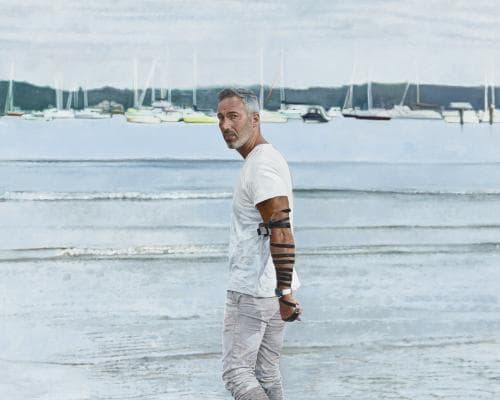
The sea is never just water. It is memory, ritual, and sometimes, a quiet reckoning. That’s where Michael Zavros found Alex Ryvchin in early January, on a beach in Sydney’s east. Weeks earlier, the Bondi terror attack had shattered the city’s sense of safety, and Ryvchin — co-head of the Executive Council of Australian Jewry — had been the steady voice for a community in shock. Zavros, a celebrated portraitist, didn’t just want to capture a face. He wanted to paint the weight of what that face carried.
Zavros and Ryvchin share an uncanny resemblance — a fact that began as a family joke. “A few years ago, my mother thought she saw me on TV, but it wasn’t, it was Alex,” Zavros recalled. That likeness became the seed of something deeper. When Zavros reached out to Ryvchin after the attack, he found a man who spoke with “clarity and conviction about the grief within his community and the changes he feared were emerging in our nation.” It was not just a portrait commission; it was a tribute to moral clarity in a fractured moment.
The painting that emerged — *Alex with his tefillin in the sea* — is a study in layered meaning. Ryvchin stands waist-deep in water, wearing tefillin, the small black leather boxes and straps worn during Jewish prayer. The sea, Zavros said, “carries so much rich symbolism” — of immersion, of tears, of the tide of history. The tefillin, Ryvchin explained, is “something that binds Jewish people to thousands of years of custom, it binds us to our almighty, and for me personally, binds me to someone who was very dear to me, someone who I lost at Bondi. Every time I would see him, without fail, we would do tefillin together and in the moments before he was killed…” The sentence trails off, but the meaning is clear: this portrait is a memorial stitched into a prayer.
When the Archibald Prize people’s choice award was announced, the numbers spoke volumes. A record 45,769 votes were cast — the highest in the prize’s history. The $5,000 prize went to Zavros, but the real win was for visibility. In a year when antisemitic incidents were rising globally, and a terror attack had specifically targeted Jewish life in Bondi, this portrait put a Jewish leader — proudly, unmistakably Jewish — in the national spotlight. “It’s something that expresses faith, history, and belonging,” Zavros said of the tefillin, “yet too often are used to divide and to harm.” He chose to reclaim that symbol.
What makes this story resonate beyond the art world is the quiet philanthropy embedded in the act. Zavros gave his time, his craft, and his platform to amplify a leader who had been carrying a community’s grief. Ryvchin, in turn, lent his presence not for personal fame but as a vessel for collective memory. The portrait became a public gift — a way for Australians to look at a Jewish leader and see not a target, but a touchstone. The sea in the painting is not just a backdrop; it is the tears of a community, and the salt that preserves what matters.
For the culture of giving, this portrait is a reminder that philanthropy isn’t always about money. Sometimes it’s about proximity — showing up, painting the truth, and letting a nation see. Zavros and Ryvchin turned a moment of terror into a monument of resilience. And in doing so, they gave the Jewish community of Australia something rare: a portrait of their leader that is also a portrait of their hope.