The Gold Standard: Trump’s $22 Billion Reimagining of Dulles
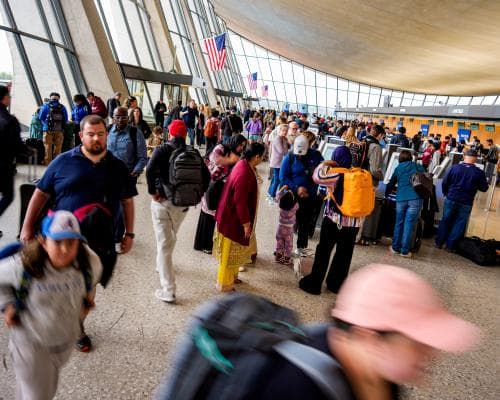
The first thing you notice when you step off a private jet at Dulles is the smell. Jet fuel, stale carpet, and the faint, institutional ghost of a thousand forgotten coffees. It’s not the scent of power. It’s the scent of a 1960s airport that has been patched together with duct tape and good intentions. But that is about to change. Donald Trump is set to announce a $22 billion plan to rebuild Washington’s main international gateway, and he has personally weighed in on the design—studying 3D models at the White House, offering changes, and demanding a vision that matches the capital’s ego.
This isn’t just a renovation. It’s a reimagining. The plan calls for five new terminals to replace the existing four, an expanded underground train system, and—most importantly—the death of the “mobile lounge.” Those slow, lumbering shuttles that ferry passengers across the tarmac like cattle in a limousine? Gone. In their place: a sleek underground pedestrian tunnel, moving walkways, and a design that leans heavily on glass and gold. Gold-mirrored ceilings throughout the terminals. The effect, I imagine, will be something like walking through a Fabergé egg—if Fabergé had a gate to catch.
But let’s talk about what this means for the traveler who doesn’t just pass through Dulles but arrives in Washington to do business, to attend a gala, to sit in rooms where decisions are made. United Airlines, which handles roughly 70% of traffic at Dulles, has agreed to help finance the project. That’s a signal. The airline knows its premium clientele—the ones who book Polaris, who expect a lounge with a view, who want the journey to feel as curated as the destination—has been grumbling for years. Dulles has long been the awkward stepchild of East Coast airports: too far from the city, too reliant on aging infrastructure, too… ordinary. For the ultra-wealthy, ordinary is unacceptable.
The price tag—$22 billion—is staggering, but it’s not just about concrete and glass. It’s about signaling. When the president personally scrutinizes 3D models and demands gold-mirrored ceilings, he is telling the world that Washington’s front door should not be a tired concourse with a coffee cart. It should be a statement. And for the traveler who values discretion, speed, and beauty, this matters. The new Dulles will likely include private suites, expedited security corridors, and lounges that feel more like a members’ club than a holding pen. The wealthy don’t want to just pass through an airport; they want to feel that the airport was designed with them in mind.
This is part of a broader pattern. Across the globe, luxury travel is no longer just about where you sleep—it’s about how you move. The private jet is the obvious choice, but even then, the ground experience matters. The car that meets you on the tarmac, the lounge that offers a quiet room with a shower, the terminal that feels like a hotel lobby. Dulles’s overhaul fits into a world where airports are becoming destinations: Changi’s indoor waterfall, Hamad’s art installations, Singapore’s butterfly garden. Now Washington wants its own icon. Gold mirrors, underground tunnels, and a train that actually works.
Where do the wealthy go next? They go where the friction disappears. They go to airports that anticipate their needs before they voice them. Dulles, with its $22 billion facelift, is betting that the future of luxury travel is not just about the destination—it’s about the threshold. And if the threshold is lined in gold, so much the better. For now, the announcement is set for 3pm at the White House, with Transportation Secretary Sean Duffy, United CEO Scott Kirby, and the airport authority standing by. The models are ready. The designs are approved. And for the first time in decades, flying into Washington might actually feel like arriving.