The New Lens: How African Filmmakers Are Rewriting the Story of Wildlife
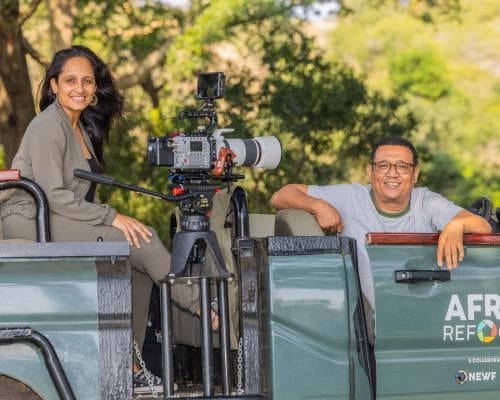
The most endangered species on the African savanna, it turns out, isn’t the pangolin or the rhino. It’s the African wildlife filmmaker. That’s the dark joke Noel Kok tells, and it lands with the weight of a census. When he and his wife, Pragna Parsotam-Kok, set out to make a wildlife series for South African TV in 2015, they hit a wall that had nothing to do with permits or poachers. They simply couldn’t find enough African filmmakers to tell African stories. The ones who existed were a handful. The stories they told were often framed by foreign crews, foreign budgets, and foreign ears. So the Koks did what any frustrated innovators do: they built a pipeline.
Their vehicle is the Nature Environment and Wildlife Conservation Trust (NEWF), a not-for-profit that started with a conference in 2017 and has since mushroomed into something far more ambitious. Today, NEWF has trained nearly 400 fellows from 37 African countries and 13 more across the global south. They’ve taught more than 200 people to scuba dive at Sodwana Bay, home to Africa’s southernmost tropical coral reefs, because you can’t film the ocean if you can’t breathe underwater. They’ve also run land-based training at Bayala, a private game reserve, and added composition workshops in 2021. The goal isn’t just to add faces behind the camera. It’s to change the grammar of wildlife documentaries—to replace Mozart with the sounds of the bush, to let the lion’s roar speak for itself.
The technology here isn’t a new chip or a drone swarm. It’s something older and rarer: access. For decades, wildlife filmmaking has been a gatekept craft, dominated by Western production houses with deep pockets and deep Rolodexes. African crews were often hired as fixers or drivers, not directors. The Koks saw that the bottleneck wasn’t talent—it was training, gear, and opportunity. So they attacked all three. The dive labs are part technical bootcamp, part cultural reset. Marine biologists who couldn’t swim learned to dive; filmmakers who’d never held an underwater housing learned to frame a reef. The result is a growing cohort of storytellers who can shoot a coral spawning or a cheetah hunt without a foreign filter. “The stories were not complete,” Noel Kok says. “They were just not authentic.”
This is not just a feel-good diversity initiative. It’s a market shift in the making. The global wildlife documentary industry is worth billions, driven by streaming giants like Netflix, Disney+, and the BBC’s Natural History Unit. Those platforms are hungry for fresh content, and they’re increasingly aware that audiences want perspectives beyond the colonial gaze. NEWF is positioning itself as a talent factory for that demand. The 400 fellows are a small number today, but they represent a multiplier effect: each trained filmmaker can train others, and each story sold to a streamer opens a door for the next one. The Koks are building what venture capitalists would call a platform play—except their platform is human, not digital.
What NEWF signals for the broader sector is a quiet revolution in who gets to frame nature. For too long, the image of Africa’s wildlife has been mediated by outsiders, often with a subtext of crisis or exoticism. The new wave of African filmmakers is more likely to show conservation successes, local stewardship, and the messy, beautiful coexistence of people and animals. That shift matters because narratives shape funding, policy, and public imagination. If the next generation of Attenboroughs comes from Nairobi or Durban, the stories will change—and so will the priorities.
The forward-looking close: The Koks are not waiting for permission. They’re building a movement one dive tank, one camera rig, one composition workshop at a time. In five years, the question won’t be whether African filmmakers exist. It will be whether the rest of the industry can keep up. The lion is still chasing the buck on the African plain—but soon, it will be an African filmmaker capturing that chase, and the soundtrack will be the real thing.
More in INNOVATION