Diiv’s Zirp! Is a Sonic Bet Against the Zero-Interest Era — and a Blueprint for Creative Reinvention
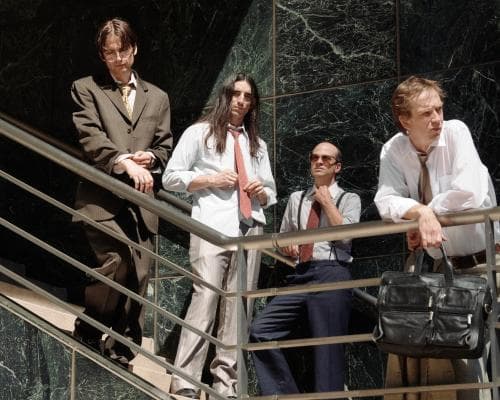
Zachary Cole Smith is wearing a tie printed with stock market tickers, and he cannot stop saying the word “fun.” A decade ago, the Diiv frontman was a different creature — a brooding, self-flagellating figure who seemed to carry the weight of every misstep he had ever made. Now, at 41, he looks like he just stepped out of a middle-management seminar in La Cañada, California, with thick-rimmed glasses and slicked-back hair, grinning like a man who has discovered a loophole in the system. The sartorial shift is not a midlife crisis; it is a visual manifesto for Zirp!, the band’s fifth album, produced by AG Cook, the neon-pop accelerationist behind Charli xcx’s most daring experiments. The title itself is a punchline — “zero interest-rate policy,” the monetary drug that inflated a decade of tech unicorns, meme stocks, and crypto casinos. Smith is not just making a record; he is making a thesis on the hangover of an era.
The irony is delicious. Diiv, the band that built its name on gauzy, motorik shoegaze — 80s goth refracted through dream-pop haze — has teamed up with the architect of hyperpop’s sugar-rush maximalism. Cook, who produced much of Charli xcx’s Brat and its remix album, is the last person you would expect to sit behind the board for a band whose previous album, Frog in Boiling Water, waded into anti-capitalist ennui. But that is precisely the point. On Zirp!, Diiv sound like they are finally having fun — not in a saccharine, sellout way, but in the subversive sense of a band that has decided to weaponize joy against the very systems that made them miserable. Smith calls it “a visual language,” and the tie is the first clue: he is dressing like the enemy to mock him from the inside.
The technology here is not silicon or software; it is sonic alchemy. Cook’s production style — glitchy, Auto-Tuned, unapologetically pop — collides with Diiv’s signature reverb-soaked guitars to create something neither camp could have predicted. It is a risky bet, one that could alienate purists who worshipped the band’s early, more austere records. But Smith has never been one to play it safe. His personal arc — from addiction to losing his home in the LA wildfires to this strange, playful rebirth — reads like a case study in creative resilience. He has said the album is about “the absurdity of pretending everything is fine when the system is melting,” and Cook’s hyperpop language gives that absurdity a soundtrack. The result is a record that feels less like a rock album and more like a transmission from a parallel universe where the 1% accidentally funded an art project.
The market context is brutal. The music industry is in a state of permanent disruption, with streaming royalties still a joke, TikTok shortening attention spans, and AI-generated tracks threatening to flood the zone. Indie bands like Diiv are caught in a squeeze: too niche for mass radio, too human for algorithmic playlists. Yet Zirp! is a calculated counterpunch. By borrowing Cook’s pop credibility and Charli xcx’s co-sign, Smith is hacking the attention economy — using the very tools of mainstream hype to smuggle in a critique of the financial system that created them. It is a playbook that other artists are watching. When a band like Diiv, whose name was practically synonymous with underground credibility, decides to embrace the enemy’s aesthetic, it signals a sector-wide shift: the old boundaries between indie and pop, between authenticity and artifice, are dissolving.
What does this say for the broader creative economy? It says that the next wave of innovation will not come from better gadgets but from better stories about the mess we are in. Smith’s journey — from darkness to a backyard in La Cañada, from addiction to a tie with stock-market emblems — is a parable for an industry that has been forced to reinvent itself every five years. The zero-interest-rate era may be over, but its psychological residue remains, and artists are the first to metabolize it. Diiv’s bet is that audiences are hungry for music that acknowledges the joke — that we are all living in a Zirp! world, where the money was fake, the growth was borrowed, and the only honest response is to laugh, dance, and make something weird.
Forward-looking, the album is a bellwether. If Zirp! lands — if critics embrace it and fans follow — it will validate a new model of artistic collaboration: pairing unlikely bedfellows to create work that defies category. Cook’s hyperpop toolkit is becoming a lingua franca for artists who want to sound contemporary without surrendering to Spotify’s algorithm. And Smith, once the poster child for indie anguish, has become a case study in how to survive the modern music business: not by hiding from the machine, but by wearing its uniform and singing its anthem in a key it does not expect. The tie is the tell. He is not wearing it ironically; he is wearing it as armor. And if that is not innovation, nothing is.