The 5 a.m. Light That Billionaires Can’t Buy: Inside Sweden’s Quietest Archipelago
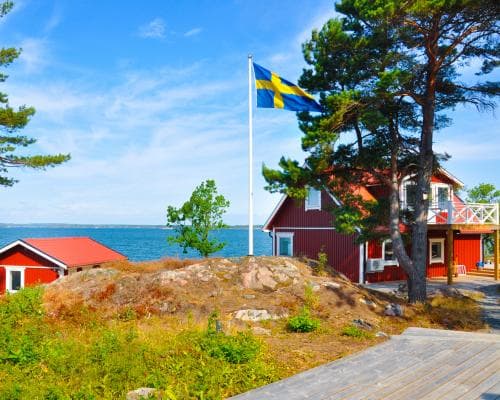
At five in the morning on Arkösund bay, the light is so bright it could be midday. The sun doesn’t negotiate here. It spills across the Baltic Sea like melted gold, turning the clapboard facade of the 1895 Arkösunds hotell into a postcard. I slip out the door as a small boat putters past, its wake catching sparks. A wooden boardwalk leads me onto a string of tiny islets. Geese arrow overhead. A mother swan coaxes her fluffy cygnets under a bridge. This is not a place you arrive at quickly. It is a place you earn.
The Östergötland archipelago—a sprawl of roughly 9,000 islands a few hours south of Stockholm—is the kind of secret that the ultra-wealthy guard like a Swiss account number. Quieter, emptier, and far more rugged than the polished isles off Stockholm or Gothenburg, it offers something money alone cannot manufacture: genuine solitude. The larger islands are flecked with traditional red timber summer houses. Seals and seabirds outnumber people. Forests of alder, cedar, oak, and pine press right up to the granite shore. This is not a destination for the impatient. My own journey began 24 hours earlier, on a Eurostar from London to Brussels, then to Hamburg via Cologne, where I boarded the SJ EuroNight Train to Norrköping. I slept while we crossed the Øresund Bridge into Sweden. Dawn unfolded in pink, dusky waves as we shuddered out of Malmö. The final leg? A 45-minute drive along a road locals call the End of the World.
Visitors navigate these waters by sailboat, motorboat, or kayak. From the Arkösund jetty, I take to the water with Åsa, a local guide, in a motorboat belonging to Kauko Lindstedt—a Finn who has spent 40 years living on the island of Aspöja, a four-mile crossing away. There is an unspoken rule here, Åsa tells me: if you spot a moored kayak or boat, you move on. That is the Swedish spirit of allemansrätten—a national law that grants everyone the freedom to roam and sleep in nature. With 9,000 islands, there is room for everyone. Aspöja is one of the few inhabited islands. Just 25 people live here year-round. Lindstedt is industrious: building, hunting, smoking fish, running boating tours. He is eager to share his home. We land at his jetty and walk across grassy meadows dotted with lumps of granite, teeming with butterflies. There are no cars. The jetty has a communal wheelbarrow for groceries and post. We meet Helen, who farms sheep and cattle, knits, tans sheepskins, keeps bees, grows vegetables, and runs the only restaurant, Forsmans på Aspöja, with her daughter. Lunch is smoked fish and boiled potatoes heaped with fresh dill, alongside a glass of Baltic seawater—filtered through the island’s small desalination plant. It is the opposite of a tasting menu. It is better.
What does this signal about wealth and taste? That the new status symbol is not a superyacht in Saint-Tropez, but the ability to slow down. To arrive by sleeper train. To know a place where the last two fishermen—brothers in their 70s, the final vestiges of a once-thriving industry—are the only ones legally allowed to cast nets. To own a summer house that costs nothing in prestige but everything in patience. The ultra-wealthy have always chased scarcity. But the scarcest resource now is not a Birkin bag or a Patek Philippe. It is a morning so quiet that the only sound is the slap of water against a hull. It is a place where you can roam freely, sleep under the stars, and never see another soul.
Look ahead. The Östergötland archipelago will not stay secret forever. As the world grows louder, the quiet places shrink. Those who know—the Lindstedts, the Helens, the brothers with craggy faces—are the gatekeepers of a disappearing luxury. The rest of us can only visit, and only if we are willing to slow down. The lesson is simple: the best things in life are not things. They are the light at 5 a.m. on a bay where the sun never negotiates.
The Experience
Book a private sleeper-cabin on the SJ EuroNight from Hamburg to Norrköping, then arrange a guided boat tour with a local islander through Arkösunds hotell’s concierge.