The $12M Squat: A Deposed Ambassador, a London Mansion, and the Ultimate Asset-Protection Play
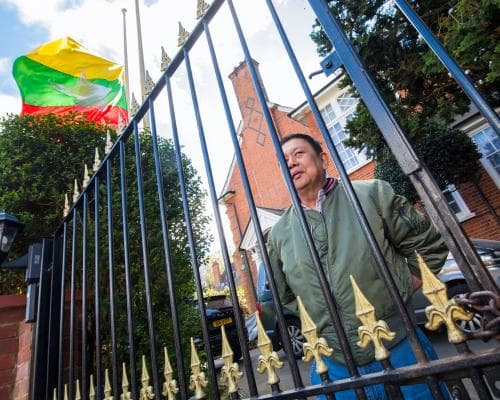
Imagine being locked out of your own office—not by a landlord, but by a coup. Then imagine refusing to leave your company-owned apartment for three and a half years, daring the new management to evict you. That's the standoff unfolding in a London courtroom, where Kyaw Zwar Minn, Myanmar's ousted ambassador to the UK, is defending his right to keep living in the ambassador's residence in northwest London. This isn't a diplomatic spat; it's a real-estate battle with a seven-figure prize, a sovereign-asset twist, and a lesson for anyone who thinks property rights are simple.
The numbers are staggering for a piece of diplomatic real estate. The residence—a sprawling, secure mansion in one of London's most exclusive enclaves—is worth an estimated £8 million to £12 million, based on comparable properties in the area. Kyaw Zwar Minn has been squatting there since May 2021, when Myanmar's military junta locked him out of the embassy itself after he declared loyalty to the deposed civilian leader Aung San Suu Kyi. He still lives in the residence, and on Wednesday he appeared in court charged with trespassing—a charge he disputes, arguing that the junta's orders are void because the general who issued them, Min Aung Hlaing, is an illegitimate ruler wanted by the International Criminal Court for crimes against humanity.
The legal mechanics are as tangled as a family trust dispute. Kyaw Zwar Minn's lawyer, David Perry, told the court that the military authorities "could not lawfully terminate his licence at the address"—meaning that, under UK law, the permission to occupy the property was granted by the legitimate Myanmar state, not by the junta. Prosecutors counter that Myanmar's authorities instructed the ambassador to "hand over state-owned properties" in April 2021, and that the UK Foreign Office also told him to leave. But Kyaw Zwar Minn's defence hinges on a subtle point: if the junta isn't recognized by most democratic countries, including Britain, then its orders carry no legal weight. So who owns the house? The exiled government? The junta? Or the man who holds the keys?
This is where the story gets deliciously weird for wealth watchers. The residence isn't just a home; it's a diplomatic asset, technically owned by the Republic of the Union of Myanmar. But in practice, it's become a personal fortress for a man who's betting that the legal concept of "legitimacy" will trump raw power. The court will have to decide whether the junta's instruction to vacate—delivered through official channels—constitutes a lawful eviction, or whether Kyaw Zwar Minn's refusal is a form of civil disobedience with property-law teeth. His lawyer's argument is essentially: "You can't evict someone if the person doing the evicting has no legal standing." It's a novel defence, and it's already drawn comparisons to other high-stakes squats, like the famous case of the Duke of Westminster's tenants who refused to leave.
For the wealthy, this is more than a legal curiosity. It's a stark reminder that property rights are only as strong as the legitimacy of the power that enforces them. In stable markets, we take for granted that a deed, a lease, or a diplomatic agreement is ironclad. But when a regime changes—whether through a coup, a revolution, or a contested election—the question of who holds the title can become a weapon. Think of Russian oligarchs' yachts seized in France, or Venezuelan gold frozen in London. This case is the diplomatic equivalent: a state's asset, held by a man who refuses to recognize the new boss, and the courts are left to sort out the mess.
The market signal here is subtle but real. Prime London real estate has long been a safe haven for global elites—a place to park capital when home markets turn volatile. But this trial exposes a hidden risk: even the most secure-looking property can be tangled in political disputes that take years to resolve. For the ultra-wealthy, it's a cautionary tale about due diligence. If you're buying a property from a government or a politically exposed person, you need to ask not just "Who owns this?" but "Who has the legitimate right to sell it?" A title can look clean on paper, but if the seller's authority is contested, you could inherit a legal nightmare.
As the trial unfolds, Kyaw Zwar Minn remains in the residence, a living symbol of defiance against a junta that has plunged Myanmar into economic chaos. The court's ruling—expected later this year—will set a precedent for how UK law treats assets held by unrecognized regimes. For wealth builders, the takeaway is clear: in a world where power shifts fast, the smartest capital isn't just about yield or growth. It's about legal clarity. And sometimes, the most valuable asset is the one you can defend in court, not just in the market. For now, the former ambassador is holding his ground—and his mansion—while the world watches to see if legitimacy can beat force in a London courtroom.