Tadej Pogacar’s Fifth Tour de France Win Is a Lesson in Compound Dominance — and What the Wealthy Can Learn From It
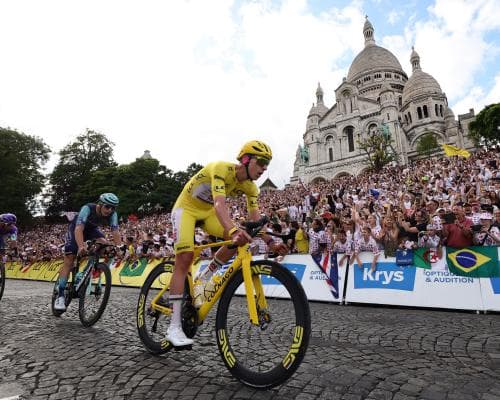
Imagine waking up every morning knowing that no matter how hard you work, the person ahead of you is simply better financed, better supported, and better positioned. That’s the reality for every other cyclist in the Tour de France right now — and it’s a feeling investors in crowded markets know intimately.
Tadej Pogacar just won his fifth Tour de France, tying the all-time record held by legends Jacques Anquetil, Eddy Merckx, Bernard Hinault, and Miguel Indurain. At 27 years old, he’s already in the pantheon. But the real story isn’t just the trophy count. It’s the mechanics of how he got there — and what that tells us about wealth, power, and market concentration in 2026.
Pogacar didn’t just win. He suffocated the race. From the opening time trial on Montjuic to the final sprint on the Champs-Élysées, he broke records on the Col du Tourmalet and Alpe d’Huez — two of the most brutal climbs in cycling. He shepherded his protégé, Isaac del Toro, to third place overall. He made Jonas Vingegaard crash out. He turned the Tour into a coronation. This wasn’t a contest. It was a capital deployment strategy.
Look at the numbers. Pogacar’s UAE Emirates XRG team is the richest in the peloton — think of it as the Blackstone of cycling. They spend aggressively on data analytics, nutrition science, and aerodynamic engineering. They poach top talent. They build moats. When Pogacar attacks, he does so with the full weight of a multi-million-dollar machine behind him. That’s not just athletic dominance. That’s the power of compounding resources over time.
For the wealthy, this is a masterclass in the economics of incumbency. In markets, the same dynamic plays out daily: a handful of mega-funds, AI leaders, and coastal real estate portfolios pull away from the pack. The gap between the top 1% and everyone else isn’t just about luck. It’s about having the capital to reinvest in your own advantage — year after year, climb after climb.
What does Pogacar’s win signal for markets right now? First, that concentration is accelerating. Just as he has no equal in the Tour, a small number of stocks — think Nvidia, Microsoft, the usual suspects — are dominating indices. Second, that the cost of entry is rising. To compete, you need a war chest. Evenepoel, the Olympic road race champion, would have won most Tours in history. But in this era, he’s a footnote. The same goes for startups trying to break into AI or biotech without billionaire backing.
Eddy Merckx, the greatest cyclist ever, said Pogacar “won’t be content just to draw level” — he’ll likely break the record for Tour victories. That’s the forward-looking takeaway for wealth builders: don’t assume the top will plateau. The best players keep compounding. They get leaner, meaner, more driven. They don’t rest on records. They rewrite them.
So whether you’re managing a family office or just your own portfolio, take the lesson from the Champs-Élysées: dominance is a strategy, not an accident. Invest in your edge. Build your team. And don’t expect the competition to get any easier — because the guy in the yellow jersey is just getting started.