Empires of Imagination: Inside the £600M Theme Park Kingdom and Its Shadowy Kremlin Liaison
Imagine a place where knights joust at dawn, where medieval villages rise from the Cotswold mist, and where a thousand years of British history unfold as a live, breathing spectacle. Now imagine the hands that built it. They are not the hands of a British heritage trust, but of a French dynasty with a taste for the theatrical—and, it turns out, a curious appetite for the company of autocrats. As Puy du Fou prepares to break ground on a £600 million theme park in Oxfordshire, the glossy brochures will sell you archery and banquets. But the real story, the one whispered in boardrooms and now confirmed by documents, is a tale of sanctioned oligarchs, Crimean sunsets, and a family that once offered Vladimir Putin the keys to its kingdom. For the ultra-wealthy, where you spend your leisure is a statement. This is a masterclass in how that statement can be complicated.
The facts, as they emerge, read like a le Carré novel. In the spring of 2014, as Russian soldiers in unmarked green uniforms flooded Crimea, Washington and Brussels moved to isolate Putin's inner circle. Among the first sanctioned was Konstantin Malofeyev, a bushy-bearded media baron with a fervent ultranationalist ideology, known in certain circles as the 'Orthodox oligarch'. While the West recoiled, one French family leaned in. A month after the EU sanctions took effect, Philippe de Villiers and his son Nicolas—the visionary duo behind Puy du Fou, the world-renowned historical theme park—flew to Yalta. In the gilded halls of the Livadia Palace, where Stalin, Roosevelt, and Churchill once redrew the world map, de Villiers sat with Putin to discuss building two new parks, one in the newly occupied Crimea, in partnership with Malofeyev. Their mission, they said, was to 'highlight Russia's history and the significance of Russia's soul.' It was a partnership that would quietly persist for over a year, well beyond the date the company has publicly claimed it severed ties.
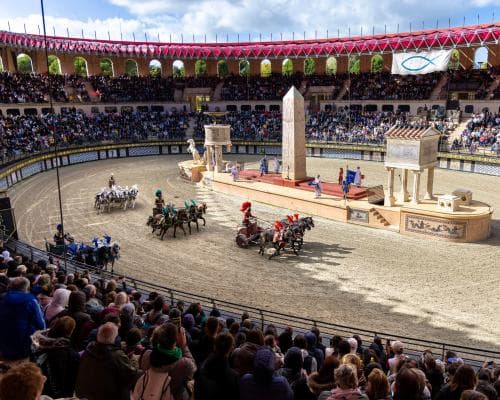
For those who collect rare experiences, Puy du Fou is a name that evokes wonder—a place where history is not displayed in glass cases but performed with thousands of actors, horses, and pyrotechnics. It is the gold standard of immersive heritage, a park that has won international acclaim for its artistry. The new Oxfordshire venture promises the same: mock medieval castles, themed villages, hotels, and re-enactments spanning from the Magna Carta to the Blitz. The craftsmanship is undeniable. But the provenance of the vision is now under a microscope. Documents suggest that Puy du Fou worked with Malofeyev's company until August 2015, made payments to a key aide, and that executives openly discussed the risk of breaching sanctions. The company's own claim that it 'began winding down' the partnership in July 2014 appears, at best, a polite fiction.
What does this tell us about the luxury market? First, that the very concept of 'heritage' is a curated narrative, as much about omission as inclusion. For the wealthy, buying into a brand like Puy du Fou is not just purchasing a day out; it is an investment in a story, a mythos. The de Villiers family understood this better than most. They built an empire on the power of story, and then, when the Russian dream collapsed, they simply pivoted. The documents reveal discussions about new horizons—including Iran, and a Shanghai park where the Chinese Communist Party was granted script approval. For a family that once decried European leaders as 'irresponsible' and offered to swap them for Putin, the willingness to embrace other autocratic regimes is less a political stance than a business strategy. It is a reminder that in the upper echelons of global commerce, ideology is often a flexible currency.
The Oxfordshire park will likely be a triumph, a jewel in the crown of British leisure. It will draw crowds, create jobs, and offer a fantasy of history that is safe, sanitized, and spectacular. But for the discerning few who read between the lines, it also offers a darker lesson: the same hands that craft our dreams often have ink on their fingers. The question is not whether the park will be beautiful—it will be—but whether the beauty can be separated from the shadows that made it possible. As the gates prepare to open, the most exclusive invitation in England may not be to the opening gala, but to the boardroom where the real story is told. For the ultra-wealthy, the ultimate luxury is knowledge. And in this case, that knowledge is not for sale.
Looking ahead, the park is set to become a landmark, a place where families will create memories against a backdrop of faux battlements and fire-breathing dragons. But the legacy of its founders will be a more complex tapestry, one where the threads of ambition and principle are hopelessly tangled. In the world of high-end leisure, the past is always a performance. The only question is who is writing the script. For now, the stage is set in Oxfordshire, and the curtain is rising on a story that is far more interesting than any medieval pageant.
The Experience
For a private preview of Puy du Fou's Oxfordshire grounds and a curated conversation on the business of heritage, contact our concierge desk for an invitation-only briefing.