The Box's Algorithm of Place: How Plymouth's Museum Is Rewriting the Code for Civic Cultural Infrastructure
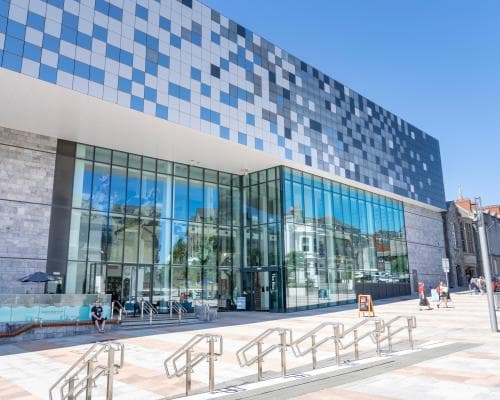
In an era where billionaires race to colonize space and AI labs burn capital on foundational models, a quiet but profound innovation has emerged from a former warehouse in Plymouth: The Box. Its recent coronation as the 2026 Art Fund Museum of the Year—a £120,000 prize—is not merely a cultural laurel. It is a proof-of-concept for a new class of civic institution: the deep-tech museum as a socioeconomic engine. The Box has demonstrated that when physical archives, digital interfaces, and community co-creation are woven together with surgical precision, a museum can become a compounding asset—generating £100 million in health and wellbeing benefits and a £244 million economic multiplier, all while drawing 1.3 million visitors through its doors since 2020. This is not heritage preservation; it is infrastructure for the attention economy, reimagined for the public good.
The breakthrough here lies in the operational architecture. The Box is not a static repository of 2 million artworks and objects; it is a dynamic platform that uses archival AI to surface overlooked histories—such as those of the Windrush community—and pairs them with immersive spatial computing experiences. Its partnership with the University of Plymouth creates a feedback loop between academic research and curatorial practice, effectively treating the museum as a living laboratory. The judges, including broadcaster June Sarpong, praised its “ambitious and welcoming approach,” but the real signal is in the data: 89% of local schools engaged, a £244 million economic injection, and a reported £100 million in health benefits. These are not vanity metrics; they are the KPIs of a new asset class.
The capital and players behind this shift are instructive. While The Box is publicly funded—part of Plymouth City Council’s long-term cultural investment—its model is increasingly attractive to private capital. The Art Fund prize, the world’s largest museum award, is a bellwether for where elite philanthropy is heading. High-net-worth individuals and family offices, traditionally focused on hospital wings and university buildings, are now eyeing cultural infrastructure as a vehicle for place-based impact investing. The Box’s ability to quantify social return on investment—through health outcomes, educational attainment, and local GDP growth—makes it a template for the next generation of civic projects. This is the Bloomberg terminal version of museum management: data-driven, outcome-oriented, and scalable.
In the competitive landscape of cultural institutions, The Box’s rise signals a tectonic shift. Traditional museums are grappling with declining foot traffic and donor fatigue; the average large US museum saw a 30% drop in attendance post-pandemic. Meanwhile, immersive digital experiences—from TeamLab to the Sphere—have captured the public imagination and the wallets of venture capital. The Box occupies a rare middle ground: it is neither a dusty archive nor a pure tech spectacle. It leverages digital tools to deepen physical engagement, not replace it. Its success challenges the prevailing wisdom that cultural relevance requires a blockbuster loan from the Louvre or a celebrity architect. Instead, it argues that deep localism, powered by smart technology, can outperform globalized spectacle.
What this means for the sector is a redefinition of the museum’s role in the urban stack. We are moving from the museum as a destination to the museum as a utility—a node in the city’s social, educational, and economic grid. The Box’s model suggests that cultural institutions can function like infrastructure-as-a-service: generating measurable returns on wellness, learning, and local supply chains. For deep-tech investors, this opens a new frontier: museum tech stacks that integrate IoT sensors for visitor flow optimization, AI for collection discovery, and blockchain for provenance and fractional ownership of digital twins. Startups like Artivive and Museum of the Future are already building pieces of this puzzle, but The Box offers a holistic blueprint.
Looking ahead, the implications extend beyond museums. As cities compete for talent and capital in the post-pandemic world, cultural infrastructure will become a differentiator in the same way that airports and fiber networks once were. The Box’s success—built on a £14 million investment and a relentless focus on inclusion—proves that the most innovative technology is not always a chip or a rocket. Sometimes it is a civic institution that uses data, design, and community trust to rewrite the operating system of a place. For the billionaires and elite capital tracking the future of the built environment, The Box is a signal: invest in the algorithms of belonging, not just the algorithms of prediction. The museum of tomorrow is a platform, and its API is open to the city.
More in INNOVATION

The $1.3 Trillion Exodus: How America’s Community Bankers Are Fighting to Keep Rural Wealth From Vanishing Into Crypto’s Black Hole

The Next Frontier in Crypto Crime: Predatory Seed-Phrase Recovery Scams Signal a Darker Fintech Underbelly
The Sovereign Mind: OpenAI’s GPT 5.6 Sol and the New Geometry of Power