A Quiet Revolution: The Art of Sanctuary in the Age of Angels
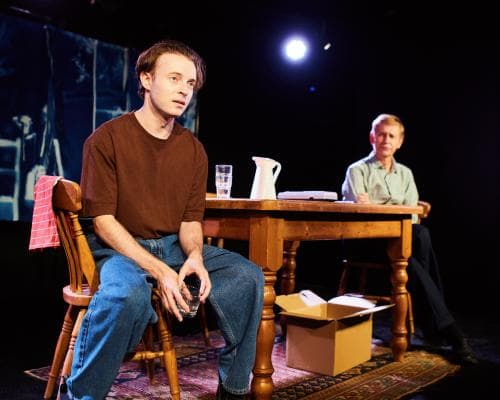
The Edinburgh International Festival is a city of grand gestures—orchestras swelling, choruses rising, and the monumental return of Tony Kushner's *Angels in America* filling the largest stages with its operatic grief. But in a smaller room, down a side street where the hush is thicker than the Scotch mist, something else is happening. Jacob Sparrow's *Sanctuary* is a debut so quiet it almost feels like a confidence. It is a two-hander, a miniature, a jewel box of a play that manages to capture the desperation and, astonishingly, the joy of young men living with AIDS in the 1990s. It is the kind of work that reminds you why we still gather in dark rooms to watch other humans breathe.
Sparrow’s inspiration is a real-life scandal that now feels almost absurdly distant: the public fury in a Suffolk village over plans to build an AIDS hospice. The villagers, as the play’s characters ruefully note, were less concerned about the residents than about the potential contamination of their cows. It is a detail so perfectly, painfully English that it could be from a satire—but Sparrow treats it with the gravity it deserves. Inside a house owned by a well-meaning, off-stage woman who has offered sanctuary instead, two men meet in a kitchen. Michael (Matthew Tennyson) is young, infected, and simmering with anger. The other (Richard Cant) is older, unnamed, and mysteriously serene, claiming to live happily in retirement with his partner. They talk, and what unfolds is a masterclass in withheld emotion.
Tennyson’s Michael is a study in incandescent rage and barely suppressed hope. He recounts his first, blazing love, the moment he was told he was HIV positive, and the slow, brutal attrition of losing friend after friend. His anger is not just at the disease, but at a world that values bovine purity over human life. Cant, meanwhile, is the still point of the turning world—a man who has made peace with his own history, and whose quiet presence becomes a kind of balm. Directed by Josh Seymour, their performances are delicately emotional, building to moments that catch you in the throat. This is not a play about dying; it is a play about the radical act of loving while living.
There are contrivances here, plot twists you see from the first scene, and a final warmth that feels almost too neat for the subject matter. But to dismiss *Sanctuary* for its seams is to miss the point. This is a work of craft, not chaos—a deliberate, tender architecture designed to hold grief without letting it collapse into despair. The play’s real subject is not the virus, but the sanctuary itself: the fragile, human-made shelter against the storm. In an era when we speak of wellness and resilience in the language of luxury retreats and curated self-care, *Sanctuary* reminds us that the most profound refuge is often a stranger’s kitchen, a shared pot of tea, and the courage to listen.
For the collector of experiences—the one who has flown to Reykjavik for a private opera or chartered a yacht to see a solar eclipse—*Sanctuary* offers a rarer commodity: emotional authenticity. This is not a piece you buy; it is a piece you receive. It is the theatrical equivalent of a bespoke suit that fits so well you forget you are wearing it, or a first-growth Bordeaux that tastes of nothing but the place it came from. In a festival season dominated by spectacle, Sparrow’s play is a reminder that the most luxurious thing we can afford is attention. And in a world that often feels as precarious as a 1990s diagnosis, *Sanctuary* whispers a truth we all need to hear: that hope, like love, is a practice, not a promise.
As the festival closes and the crowds disperse, *Sanctuary* will linger in the mind like a half-remembered melody. It is a debut that announces Sparrow as a writer to watch, and a production that deserves a life beyond Edinburgh. For those who seek out the rare, the intimate, and the true, this is the ticket to hold. It is not a revival of an era-defining classic; it is a new classic in its own right, small in scale but vast in heart. And in a culture that increasingly trades in noise, that quietness is the ultimate luxury.