The Daisy Wheel Deception: Why the Ultra-Wealthy Are Reconsidering Their Medieval Manor’s ‘Witches’ Marks’
Imagine you’ve just closed on a 14th-century barn in the Cotswolds. The stone walls are thick, the beams are blackened oak, and the estate agent whispered that the carvings near the lintel are ‘witches’ marks’—ancient symbols meant to trap demons. You pay a premium for that story. It feels like owning a piece of magic. Only now, a leading architectural historian has called that entire narrative a fairy tale. And for anyone who collects heritage property, that changes everything.
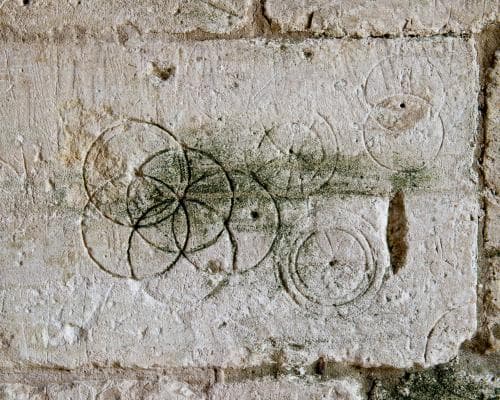
Jennifer Alexander, a professor of architectural history at Warwick University, has spent years studying the scratches and circles carved into England’s most venerable buildings. Her conclusion is blunt: there is “absolutely no evidence” these marks have anything to do with witches or supernatural protection. The so-called hexafoils and daisy wheels that English Heritage and Historic England have promoted as ritual protection symbols are, in her words, “practical geometry”—the doodles of stonemasons teaching apprentices how to use a compass on stone. “Do you remember at school when you were first given a pair of compasses and you made a daisy wheel?” she asks. “It’s that.” Hundreds of these marks exist, varying in skill, and they are simply training exercises, not spells.
The implications are significant. English Heritage, the charity that oversees 400 historic sites, announced in 2024 that Gainsborough Old Hall in Lincolnshire contained the most “apotropaic marks” ever found at any of its properties—a staggering array of circles, overlapping Vs, and pentangles. They told the public these were carved to trap demons and call on the Virgin Mary for protection. Historic England, the government’s heritage advisor, even launched a public hunt for such marks in 2016, framing them as relics of a superstitious past. But Alexander dismisses this as a romantic fiction: “Anything on a stone building that looks like a design gets picked up as these damn things now.”
For the ultra-wealthy, this is not an academic squabble. It is a question of provenance and value. When you acquire a medieval hall or a restored tithe barn, the story woven into its fabric is part of the asset. A ‘witch mark’ adds mystique and marketability. But if those marks are merely apprentice geometry—the equivalent of a carpenter’s pencil line—the romance evaporates. The real rarity, Alexander suggests, lies not in the supposed magic but in the craftsmanship itself. A daisy wheel carved by a 14th-century mason is a testament to the skill of working an “intractable surface like stone” with nothing but a compass and a straight edge. That is the true heritage: the human hand, the patient geometry, the training of a trade that built cathedrals.
This revision matters because the luxury market is built on stories. A pentangle on a beam might once have been sold as a protective charm; now it is a student’s practice piece. The shift in interpretation does not devalue the stone—it reframes it. The wealthy collector who understands this trades superstition for connoisseurship. They see not a talisman but a lesson in medieval pedagogy, a tangible link to the apprentices who learned their craft in the shadow of vaulted ceilings. It signals a deeper taste: one that values authenticity over folklore, and provenance over paranormal.
Looking forward, expect a quiet recalibration among estate agents and heritage consultants. The most discerning buyers will commission their own surveys, not for ghosts, but for the quality of the mason’s geometry. The daisy wheel will be appreciated as a sketch, not a spell. And the next time you stand in a candlelit hall, tracing a circle carved into the stone, you will know the truth: it was not meant to trap a demon. It was meant to teach a hand how to draw a perfect line. That, in its own way, is far more extraordinary.
The Experience
Arrange a private tour of Gainsborough Old Hall with a dedicated architectural historian to examine the daisy wheels firsthand—contact your heritage property advisor for bespoke access.
Explore