The Last Mile: Where India's Polio Warriors Walk Before Dawn
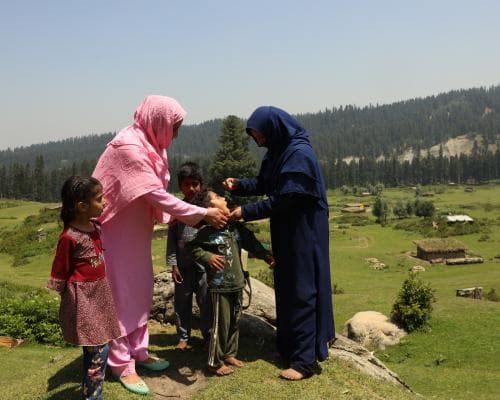
Before the first prayer call curls over Pulwama's rooftops, Shameema is already checking her cargo — not silk, not saffron, but something far more precious: a small insulated box of polio vaccine, its ice packs held at a precise 2–8°C. She wears worn rubber sandals. Tanzeela, 28, reties her canvas laces. Together, they step into the dark, leaving behind the valley's summer heat of 37°C for the cool, thin air of the pine forests above. Their destination is Namblan, a meadow that appears on no tourist map, where nearly 50 dhokas — the seasonal mud-and-stone homes of Gujjar and Bakarwal nomads — scatter across the hillsides like forgotten dice.
This is not a journey for the faint-hearted, nor for those who measure travel in five-star comfort. The asphalt dissolves into dirt track, then into a footpath that clings to the forest floor. Electricity lines stopped long ago; horses are the only transport for families who spend summers here, grazing flocks in high pastures. But for Shameema, 45, and Tanzeela, this is the most important commute in India. They are part of a 2.5-million-strong army of frontline health workers — the human machinery behind the world's largest immunisation campaign. Shameema alone has administered polio drops to more than 3,000 children, her count kept not in a ledger but in the faces she remembers.
One face haunts her: a boy in her village with a deformed leg, a legacy of polio from before India's eradication. “I saw that child struggle to walk to school,” she says, pausing by a stream. “His mother held him on her back until he grew too heavy. These mountains need protection too — the children here deserve the same health as those in the cities.” It is this memory that propels her up the trail each morning, past stands of pine that would make a landscape painter weep, past streams that taste of snowmelt, past the last signs of the world she knows.
The logistics of this journey are a masterclass in precision under pressure. The cold chain — that fragile thread of temperature control from factory to forest — must never break. Ice packs are checked, rechecked, and swapped at strategic points. A single degree above 8°C and the vaccine is useless; a single missed settlement and a child remains vulnerable. The women carry their own water, their own food, and the weight of a nation's promise. They are not accompanied by camera crews or government ministers. They walk alone, often in silence, their sandals and canvas shoes worn thin by the very ground they cover.
What makes this story extraordinary is not the technology — there is none, just ice and willpower. It is the sheer, relentless humanity of it. For the wealthy traveller who has flown business class to Srinagar and hired a jeep for a day trip to the meadows, the idea of walking hours to deliver a drop of liquid to a nomad child might seem like another world. But it is the same world. The same mountains. The same pine air. The difference is in what we choose to see. Luxury, in its truest sense, is the ability to protect — and these women protect with their feet.
This is also a story of what the ultra-wealthy rarely see: the invisible infrastructure of care that makes a society civilised. While private jets ferry the elite to Himalayan retreats, these women ferry immunity to the forgotten. They are the ultimate concierge service, but their tip is a child's smile. In an era where luxury travel is increasingly about purpose — conservation, community, connection — the Namblan walk offers a profound lesson. The rarest experience in the world today is not a private island or a bespoke safari; it is the sight of a woman in worn sandals crossing a stream at dawn, carrying hope in an insulated box.
So where do the wealthy go next? Perhaps not to Namblan itself — the path is too rough, the welcome rightly reserved for those who serve. But they can carry its spirit. They can fund the cold chains, support the vaccinators, and understand that the most beautiful view in Kashmir is not from a houseboat on Dal Lake, but from the perspective of those who walk for others. Shameema and Tanzeela will keep walking, long after the wealthy have flown home. Their journey is not a trip; it is a vocation. And in the rarified world of luxury travel, there is no greater privilege than to witness such devotion — or to make it possible.