The Scream of Labor: Edvard Munch’s Chocolate Factory Frieze and the Bitter Cost of Sweetness
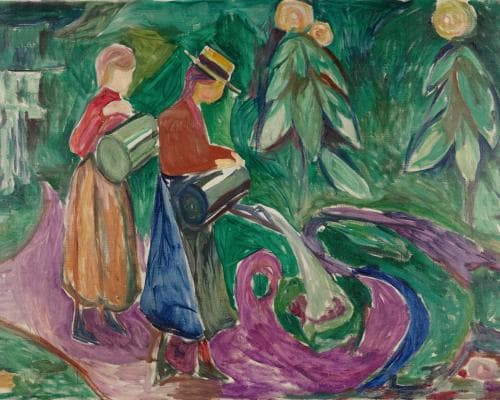
Imagine sitting down to lunch in a factory canteen, your sandwich in hand, and looking up to find a dozen Edvard Munch originals swirling across the walls. Not The Scream—something softer. A dance of fruit pickers, synchronized swimmers, and couples moving arm-in-arm across a blue-green beach. That was the reality for the young women who worked at Freia, Norway’s legendary chocolate company, starting in 1923. For nearly a century, this frieze stayed inside the factory, hidden from the world. Now, for only the second time in history, it has left the building. And the story it tells is far richer—and far more uncomfortable—than any chocolate bar.
Commissioned in 1922 by Freia’s owner, the frieze was meant to brighten the women’s canteen. Twelve canvases, all by the man who gave us existential dread on a bridge. But here’s the twist: Munch wasn’t painting the workers’ reality. These girls—often called “chocolate girls”—toiled long hours, had no summer cottages, and rarely saw the sea. Munch painted them a fantasy. “The little chocolate girls, sat there eating, understanding the pictures better and better,” he wrote after a visit. He even added doors and chimneys to the houses after they complained. The frieze was a lesson in aspiration, not documentation. And the company that paid for it? Freia sourced its cacao from South America, the Caribbean, and later Ghana—then a British colony—through networks built on exploitation and colonial violence. The exhibition at Oslo’s Munch Museum, titled Edvard Munch and the Chocolate Factory, is the first time the frieze has been shown publicly in Norway. It runs until October, while Freia’s canteen undergoes renovations.
Let’s talk rarity. These twelve canvases have never been on the market. They are not for sale. They are a corporate commission that became a national treasure, locked inside a chocolate factory for generations. The only previous public showing was in Stockholm in 1968. That means even the world’s top collectors—the ones who chase Munch’s prints, pastels, and paintings—have never had a chance to own a single panel. The frieze is irreplaceable. And while Munch’s market is astronomical (one version of The Scream sold for $120 million in 2012), the Freia frieze is priceless in a different way: it is a complete, site-specific narrative, inseparable from the building and the social experiment it was born from. The craftsmanship is pure Munch—loose, emotional brushwork, blues and greens that seem to vibrate—but the context is what makes it singular. It is art as corporate patronage, as social engineering, as a mirror held up to a company’s conscience.
What does this signal about wealth and taste today? That the ultra-wealthy are increasingly hungry for stories, not just objects. A Rothko on the wall is impressive. A Munch that once hung in a chocolate factory, paid for by a colonial-era fortune, and seen by generations of working women? That is a conversation piece for a different league. It signals a shift from pure acquisition to provenance as power. The frieze’s journey—from factory canteen to museum gallery—mirrors the luxury market’s growing appetite for objects with layered, sometimes uncomfortable histories. It also reminds us that the line between philanthropy and propaganda is thin. Freia wanted to appear benevolent. Munch wanted to educate. The workers wanted doors on the houses. The truth is somewhere in the bitter cacao fields. For the collector who values complexity, the Freia frieze is a masterclass in what money can buy—and what it can’t erase.
Looking ahead, the frieze will return to Freia’s canteen after renovations. But the conversation it has started won’t go back in the box. As the luxury world grapples with its own sourcing stories—from diamonds to cashmere to chocolate—Munch’s hidden masterpiece becomes a touchstone. It asks: can beauty be separated from the system that funded it? And for those with the means to commission their own legacies, the lesson is clear: your walls will tell a story, whether you intend it or not. Make sure it’s one you’re willing to have told.
The Experience
Book a private, curator-led tour of the Munch Museum’s Edvard Munch and the Chocolate Factory exhibition before it closes in October. Contact the museum’s VIP concierge for after-hours access.