The Curious Case of the Galloping Cure: Opera's Darkest Carnival Comes to Town
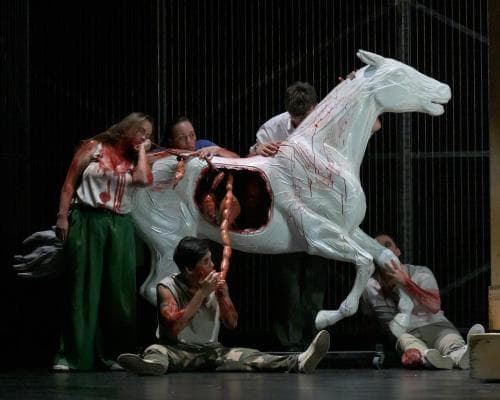
There is a moment in The Galloping Cure when a chorus of hallucinogenic sheep takes the stage, and you realize you are not in for a polite evening at the opera. This is music theatre with a bite — a dark, glittering carnival ride through the American heartland, where the cure is worse than the disease. The new work from composer Missy Mazzoli and librettist Royce Vavrek, the duo behind the acclaimed Breaking the Waves, is a world premiere that has the Edinburgh Festival circuit buzzing. It is not comfortable. It is not pretty. It is, however, utterly unmissable.
The story, based on an original tale by Karen Russell and inspired by Kafka's A Country Doctor, follows Dr. Theresa Hart, a small-town physician grappling with a community worn down by chronic pain and disillusionment. Enter Lucky Mack, a charismatic sideshow huckster whose traveling carnival promises release — a euphoric "flying" sensation on his carousel, with the first ride always free. At first, Dr. Hart endorses the galloping cure, seeing it as a miracle for her suffering patients. But Mack's methods soon reveal a sinister edge: two-rides-a-week limits, surge pricing, and a creeping dependency that turns desperation into death. The allegory is thinly veiled, and the parallels to America's opioid epidemic are stark, but the opera's power lies in its refusal to look away from how easily ordinary people — the elderly, the vulnerable, and most tragically, children — are swept into the undertow of a system designed to exploit their pain.
Mazzoli's score is a masterclass in controlled chaos. The musical language is direct yet spikily sophisticated, with a brassy, in-your-face quality that veers from creepy carny vibes to club beats supplied by Blume and Lorna Dune. A battery of percussion underpins the action, while Vavrek's libretto swings between poetic lyricism and biting satire. The vocal lines are eminently singable, even as they twist into angular, uncomfortable shapes. This is music that demands your attention, that rewards the listener with moments of startling beauty amid the dissonance. Tom Morris's staging for Scottish Opera and Opera Ventures Productions is admirably clear, even when the stage fills with those hallucinogenic sheep — a surreal touch that somehow grounds the story in its Kafkaesque roots.
For collectors of cultural experiences, The Galloping Cure is the kind of work that defines a season. It is the opera equivalent of a rare, limited-edition piece — not because it is precious, but because it is fearless. In a world where luxury often means comfort, this is luxury of a different kind: the privilege of witnessing artists take risks, of seeing a story told with unflinching honesty. The production is a reminder that the ultra-wealthy, who can afford any diversion, increasingly seek out experiences that challenge rather than soothe. A private box at the opera is no longer enough; the discerning want to be unsettled, to feel something beyond the velvet cushion.
The market for such boundary-pushing work is niche but devoted. Mazzoli and Vavrek have carved a space for themselves as the enfant terribles of contemporary opera, and their following among tastemakers and cultural investors is growing. This is not the Met's gilded classics; it is the avant-garde's answer to the opioid crisis, wrapped in a carny's grin. For those who collect cultural moments the way others collect vintage cars or rare whiskies, The Galloping Cure is a singular acquisition — a work that will be talked about for years, dissected in salons and symposia, and remembered long after the final curtain.
What does this signal about luxury taste? That the truly refined palate craves substance over spectacle, even when the spectacle involves singing dogs and hallucinogenic sheep. The Galloping Cure is a testament to the power of art to hold a mirror to society's darkest corners, and to do so with wit, style, and a wicked sense of humor. It is not for the faint-hearted, but then again, neither is the world it reflects. As the final notes fade, you are left with a question that lingers like the last sip of a great vintage: what will we do when the cure is worse than the disease? The opera doesn't answer, but it makes sure you cannot look away.