The Pentagon's Ammo Problem Is Now a Market Signal
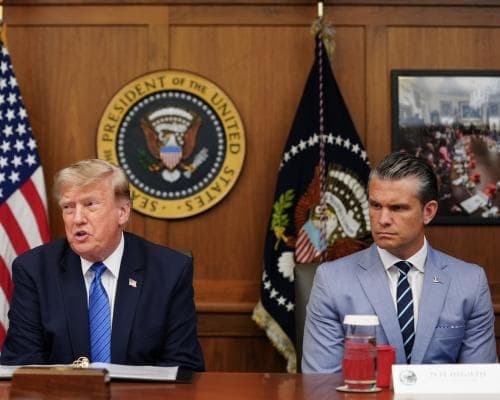
There's a rule on Wall Street that never makes it into the fancy pitch decks: when a president starts praising a cabinet member on Truth Social, it's usually because the truth is somewhere else. On Tuesday, Donald Trump did exactly that, declaring himself 'extremely happy' with Pete Hegseth's performance as defense secretary. He called everything 'extraordinary,' cited the capture of Nicolás Maduro and the ongoing war in Iran, and dismissed reports of clashes with Pentagon leaders as 'fake news.' But the Washington Post's earlier reporting tells a different story: at Camp David last week, the president was reportedly frustrated — not with Hegseth's rhetoric, but with the extreme shortages of critical munitions that are now constraining military options in Iran. That gap between the official line and the operational reality is not just a political story. It's a market signal.
Here's the scale of the problem. The US military is fighting a war in Iran, and the price of gas has been climbing steadily for six months. Inflation has hit a three-year high. And the Pentagon is running low on the very munitions that make modern warfare possible. This isn't a niche procurement issue. It's a supply chain crisis with a price tag in the hundreds of billions. When the world's most powerful military can't replenish its arsenal fast enough, that tells you something about the state of global manufacturing, logistics, and the defense industrial base. For investors, this is the kind of inefficiency that creates opportunity — if you know where to look.
Let's get into the numbers. The munition shortage is a direct result of a decade of underinvestment in domestic production capacity. The US defense budget is enormous, but a large chunk goes to personnel, healthcare, and R&D, not to the kind of high-volume, low-margin production lines that crank out artillery shells, missiles, and precision-guided munitions. When the war in Ukraine exposed similar shortages two years ago, the Pentagon promised to ramp up. But as the Iran conflict shows, the gap between promise and production is still wide. The Washington Post report, citing two unnamed sources, said the president grew frustrated at Camp David about exactly this. Hegseth, for his part, has focused on culture war victories — getting rid of DEI, boosting recruitment — which are nice talking points but don't put a single new shell on a pallet.
The market angle here is sharp. Defense stocks have been on a tear, but the real money is in the supply chain: companies that make the raw materials, the precision components, and the logistics software that keep the ammo flowing. Think of it as the 'wartime industrial complex' trade. The US government has already started handing out contracts to firms like Arkel International — a Louisiana-based company that just got the first construction contract from Trump's Board of Peace, a 150-person military outpost in Gaza to house Moroccan troops. That's a small deal, but it's a sign that the administration is moving from talk to action, and that money is starting to flow into very specific corners of the defense and infrastructure world.
For the wealthy, this is a moment to think about how geopolitical risk translates into portfolio risk. Gas prices are already up, inflation is creeping higher, and the US military's ability to project power is now explicitly tied to its ability to buy bullets. That's a recipe for more fiscal spending, more debt, and more pressure on the Fed to keep rates higher for longer. The bond market is watching. The equity market is watching. And the smart money is already repositioning toward companies that benefit from the rearmament cycle — not just the primes, but the obscure suppliers that make the alloys, the fuses, and the guidance systems.
What does this mean going forward? First, don't trust the spin. The president's 'extremely happy' message is designed to stabilize the narrative, but markets are not fooled by press releases. Second, watch the Pentagon's procurement announcements over the next 90 days. If we see emergency contracts for munitions, that's a bullish signal for the defense supply chain. If we see more talk and no action, the gap between rhetoric and reality will only widen — and that's a risk factor for everything from oil prices to Treasury yields. Third, keep an eye on Gaza. The Board of Peace contract is small, but it's a precedent. It shows the administration is willing to use private contractors for what used to be government-led reconstruction. That's a trend that could open up a new asset class in conflict-zone infrastructure.
Ultimately, the Hegseth drama is a distraction from the real story: the US military is running on fumes, and the market is starting to price that in. For the average investor, the lesson is simple. When the most powerful military in history has to ration ammunition, that's not a political scandal. It's a buying opportunity in the companies that will fix it. And for the wealthy, it's a reminder that capital flows where the need is greatest — and right now, the need is for bullets, not buzzwords.