The Pilgrim’s Choir: A Sonic Journey Along the Camino
There is a moment in Joby Talbot’s Path of Miracles when the music stops being something you listen to and becomes something you inhabit. It begins in darkness, a low drone that hums like the earth itself, then grows, swells, and splits into notes. And then, from behind you, a chord flares — not from the stage, but from the aisle, from the pews, from the very air you are breathing. The singers of Tenebrae, Nigel Short’s chamber choir, are not performing; they are processing. They move in circles, cluster into quartets, break into duets, and reform like a living mosaic around the audience. This is not a concert. It is a pilgrimage, and you are on it.
The piece, commissioned by Tenebrae in 2005 and inspired by the Catholic pilgrimage to Santiago de Compostela, has achieved cult status among choral aficionados. It is a phenomenon as much as a score, a work that only fully reveals itself in live performance. Talbot’s music — post-minimalist patterns, hypnotic dances, chants that feel both ancient and new — is designed to inhabit space physically, not just acoustically. The singers do not stand in a row and sing at you; they surround you, move through you, and carry you along the Camino with them. In the right setting, it is transcendent.
The right setting, as Short himself admitted, is a cathedral. “Wonderful cathedrals,” he said, with their stone acoustics and their sense of sacred space. In a cathedral, the music rises and falls like incense, and the movement of the choir becomes a kind of choreographed prayer. But in St George’s Bristol, with its creaking wooden floors and the oppressive heat of a summer evening, the ritual was dragged back to earth. The scuffling of feet, the banging of doors, the faint of an audience member that derailed much of the choreography — all of it conspired to ground the heavenly in the here and now. It was still beautiful, still compelling, but it was not the rapturous experience the piece demands.
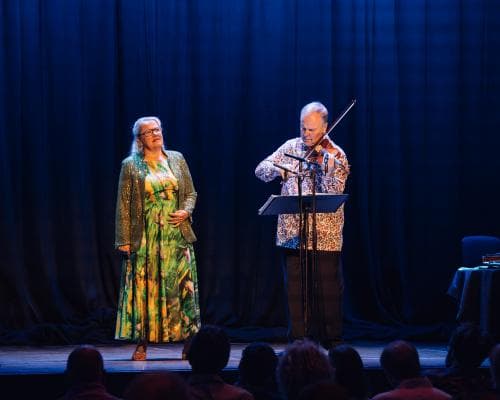
Yet, as with all great journeys, the destination was not the only point. The performance was part of the Bristol Proms, a festival that has become a pilgrimage site for adventurous listeners. And down the road at Bristol Beacon, a different kind of ritual unfolded. Sakari Oramo, the BBC Symphony Orchestra’s chief conductor, swapped his baton for a violin bow, and the act of lowering a bow onto strings became its own quiet ceremony. Where Talbot’s piece was about grandeur, Kurtág’s Kafka Fragments is about intimacy — fragments of Kafka’s writing set to music that feels like a whisper, a breath, a pause. It is the opposite of spectacle, and yet it demanded the same kind of attention, the same kind of devotion.
For the luxury traveler, this is the new frontier of cultural tourism. Not just attending a concert, but participating in a ritual. Not just visiting a cathedral, but being inside the music that was written for it. The wealthy have long traveled for art, but now they are traveling for experiences that are immersive, participatory, and deeply personal. They want to stand in the middle of a choir and feel the sound move through them. They want to walk the Camino, not as tourists, but as pilgrims — even if their pilgrimage lasts only an evening.
This is the promise of Path of Miracles: that music can be a journey, and a journey can be a prayer. And for those who can afford to chase such moments, the next step is clear. Follow the Camino itself. Walk the route from Roncesvalles to Santiago, stopping at the great cathedrals where Talbot’s music was meant to be heard. Bring a choir, or find one. And let the drones rise, and the chords flare, and the world fall away.