The Golden Hour at Scotstoun: Where Commonwealth Champions Are Made
There is a particular kind of magic that settles over a stadium when the light begins to fade and the evening’s biggest moments are still unwritten. At Scotstoun Stadium in Glasgow, the air was thick with it—a restless, expectant hum that seemed to vibrate through the concrete and into the soles of your shoes. The final session of the 2026 Commonwealth Games athletics programme had arrived, and with it, the kind of drama that no scriptwriter would dare commit to paper. A following wind—so strong it felt like a firm hand on your back—was doing its best to rewrite the record books before the runners even toed the line.
The evening’s headline act was the men’s 90+kg boxing final, a collision of raw power and tactical restraint between India’s Narender Narender and England’s Damar Thomas. Narender, visibly fatigued after a long campaign, began to fade in the second round, his guard dropping just enough for Thomas to slip through with a combination that landed with the crisp finality of a champagne cork. By the time the bell rang, four of the five judges had scored it for the Englishman, and the crowd—a mix of tartan-clad locals and neutral connoisseurs—rose to acknowledge a performance that was as much about endurance as it was about force. It was the kind of bout that reminds you why boxing remains the most honest sport: no excuses, no replays, just two people and their will.
But the true poetry of the evening unfolded on the long jump runway, where England’s co-captain, Jazmin Sawyers, was fighting her own battle against the elements. The wind, which had been helping sprinters and hurdlers all night, was a double-edged sword here—it could carry you further, but it could also throw off your rhythm, your timing, your very sense of self. Sawyers’ first attempt was a modest 6.46m, a mark she left with a frustrated shake of her head after her left foot dragged through the pit. Not literally, of course—but in the way that athletes speak, where a misplaced toe can feel like a betrayal. Meanwhile, Nigeria’s Ruth Usoro had already announced herself with a stunning opening leap of 6.87m, a distance that seemed to hang in the air longer than the jump itself, as if the wind had decided to take a personal interest in her cause.
The night was a masterclass in the art of the possible. In the men’s pole vault, the bar rose with the tension, each clearance a small victory against gravity. In the women’s 400m T54, Scotland’s Melanie Woods carried the hopes of a nation on her shoulders, her wheelchair a blur of determination as she powered toward what the home crowd desperately wanted to be gold. And in the men’s mile, the marquee event of the evening, Josh Kerr and Jake Wightman—two of Scotland’s finest middle-distance runners—were expected to deliver a homecoming for the ages. The schedule was a symphony of climaxes: the 5000m, the relays, the 800m, the mile, the mixed relay, and finally the women’s mile, each event a movement in a larger composition that had been building for days.
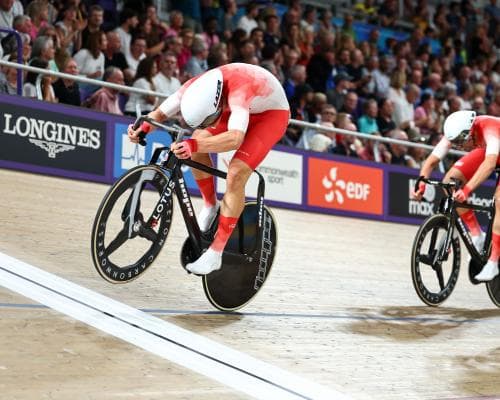
But it was the men’s 10km track race that provided the evening’s most visceral drama, a reminder that sport is never truly safe, no matter how well-choreographed. With just two laps to go, nearly half the 20-strong field went down in a pile-up so violent it sent riders sprawling across the track like a spilled box of chess pieces. Malaysia’s New Joe Lau was stretchered away, his face a mask of pain, while the rest—miraculously—walked away. Henry Hobbs, one of the survivors, described it afterward with the understated eloquence of someone who has just cheated fate: “It was so sketchy at the end, so many elbows. I’m surprised it didn’t happen earlier. It was a dogfight.” The crash was a stark reminder that even in the most controlled environments, chaos is always waiting in the wings.
For the discerning spectator, evenings like this are why we watch. Not just for the medals, but for the moments when human beings push themselves to the edge of their physical and mental limits and somehow find more. The wind at Scotstoun was a character in its own right, a wild card that could elevate a jump or sabotage a start. It was the kind of night that makes you appreciate the craftsmanship of athletic preparation—the hours of training, the meticulous attention to technique, the mental fortitude to adapt when conditions refuse to cooperate. In that sense, it was a lot like the world of fine collecting: the true value lies not in the object itself, but in the story of how it was made, and the hands that shaped it.
As the evening closed with the relays, the stadium lights blazing against the Scottish dusk, one thing was clear: the 2026 Commonwealth Games will be remembered not for its glitz or its glamour, but for its raw, unvarnished humanity. The athletes who walked off that track—some with medals, some with bruises, all with stories—reminded us that greatness is not a destination but a process. And for those of us lucky enough to witness it, the memory of that wind, that chaos, and that quiet, stubborn pursuit of excellence is worth more than any trophy. The night belonged to Glasgow, but the feeling—that electric, fleeting sense of possibility—belonged to everyone who was there.