The 50-Mile Shift: How Warming Air Is Redrawing the World’s Water Map
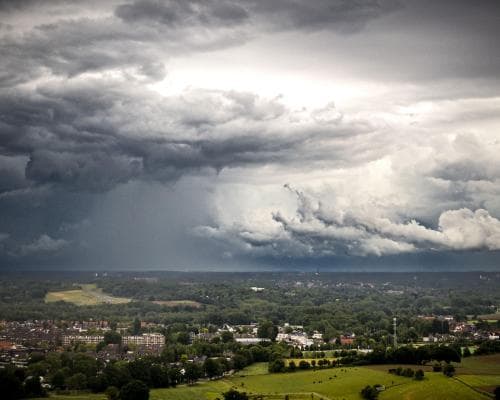
The next time you feel a raindrop on your cheek, ask yourself: how far did that drop travel to reach you? The answer, it turns out, is getting longer. A new study from the University of Wyoming, published in *Geophysical Research Letters*, has tracked atmospheric moisture movements across the United States over three decades. The finding is startling: in the southwestern and southern plains, water vapor now travels 30 to 50 miles farther—and stays aloft two to four hours longer—before it falls as rain. That is not a small tweak. It is a fundamental re-plumbing of the atmosphere.
Travis Aerenson and his colleagues built a model that essentially follows each water molecule’s journey from evaporation to precipitation. What they found is that warmer air holds more vapor—roughly 7% more for every degree Celsius of warming. That extra carrying capacity does not just mean more rain. It means rain falls in different places. The moisture that used to soak the Texas Panhandle now drifts into Oklahoma. The vapor that once fell on Arizona’s mountains sails into New Mexico. The hydrological map of the American interior is being redrawn, mile by mile, without a single treaty or pipeline.
This is not a niche climate footnote. It is a slow-motion reallocation of the most fundamental resource on Earth: water. The study’s authors note that as moisture travels farther, more evaporation is happening over oceans and less over land. That means the rain that sustains crops, cities, and ecosystems is increasingly born at sea—and its path is governed by the physics of a warming atmosphere, not by human borders. The water security of entire states and countries is drifting beyond their control. The researchers call for “greater collaboration between neighbours,” but in a world of zero-sum water politics, that is a tall ask.
The implications for agriculture are immediate and brutal. The southern plains of the US are the nation’s breadbasket. If the rain that historically fell there now falls 50 miles east, farmers face a choice: adapt their crops, invest in massive irrigation, or watch yields shrink. The same logic applies to the Colorado River basin, the Rio Grande, and every watershed that depends on distant evaporation sources. The trillion-dollar question is whether technology can catch up—through atmospheric water harvesting, precision irrigation, or cloud-seeding—before the shift outpaces our ability to adapt.
For deep-tech investors and billionaire-backed water startups, this study is a flashing red signal. The market for water security—desalination, atmospheric water generation, soil moisture sensors, and AI-driven weather prediction—is already surging. But this research suggests the problem is not just scarcity; it is geographic volatility. The rain is moving, and with it, the value of land, the viability of crops, and the stability of regions. The billionaires who bet on water will be betting on a moving target.
What Aerenson’s work reveals is that the atmosphere is not a passive backdrop. It is an active, shifting infrastructure—one that we have not yet learned to read. The trend is clear: moisture will travel farther, faster, and less predictably. The countries and companies that build the tools to track, forecast, and capture that moisture will hold the real power. The rest will be left staring at clouds that no longer break where they used to. The raindrop on your cheek has a longer journey now. So does everyone who depends on where it lands.