The Great Data Center Pause: Why New York’s Ultra-Wealthy Are Watching Albany’s AI Moratorium
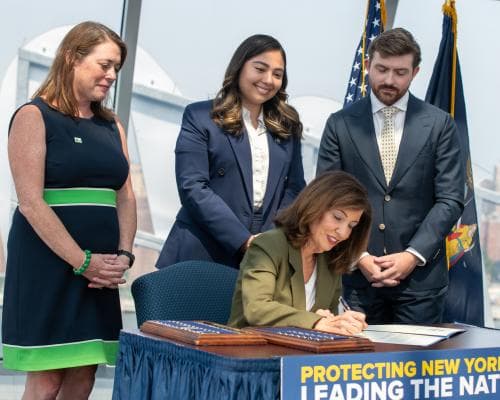
Donald Trump does not do subtle. When he took to Truth Social this week to blast New York Governor Kathy Hochul’s new statewide moratorium on hyperscale data centers, he called the facilities “big, strong, bold, and Money Machines.” He wasn’t wrong about the money — but he missed the deeper story. For the kind of people who read this desk — the ones who collect vineyards in Napa, private islands in the Bahamas, and architectural masterpieces from OMA — the real news is not a political spat. It is a sudden, dramatic shift in the geography of power.
Hochul’s executive order makes New York the first state in the nation to slam the brakes on the construction of large new data centers — the energy-guzzling, water-sucking cathedrals of artificial intelligence. The moratorium lasts one year, during which state regulators will craft new environmental and energy standards. On the surface, this is a sensible pause for a state whose grid is already strained and whose rural communities have fought data center sprawl. But for those who have been quietly assembling parcels of land near hydropower sources and fiber-optic trunk lines, the pause is a seismic event. The value of those assets just became a question mark.
Consider what a hyperscale data center actually is. These are not the server closets of yesteryear. A single facility can consume as much electricity as a small city, and as much water as a golf course in Arizona. They require vast tracts of land — often hundreds of acres — with access to high-voltage transmission lines and cooling infrastructure. For the ultra-wealthy, owning the land beneath one of these facilities has become a quiet but lucrative play. Hedge fund managers and family offices have been buying up industrial-zoned parcels in places like Niagara County, Erie County, and the Hudson Valley, betting that the AI boom would turn their dirt into an annuity. That bet just got harder.
Trump’s complaint that the moratorium will drive jobs and tax revenue to red states is not baseless. Virginia, Texas, and Ohio have been aggressively courting data center developers with tax breaks and expedited permitting. But for the collector of rare, high-yield real estate, the calculus is more nuanced. New York’s upstate regions offer something few other states can: abundant hydroelectric power from Niagara Falls, a cool climate that reduces cooling costs, and proximity to the financial and tech corridors of New York City. A one-year pause may actually increase the scarcity premium on the few parcels that are already permitted. For the truly patient collector — the one who thinks in decades, not quarters — a regulatory pause can be a buying opportunity.
What does this say about luxury taste? The old markers — a Bugatti, a Bordeaux cellar, a penthouse on Central Park West — are table stakes. The new signifiers are infrastructure assets: a stake in a data center REIT, a private water rights portfolio, or a tract of land quietly zoned for hyperscale development. It is a form of collecting that requires not just capital but regulatory literacy and a stomach for uncertainty. The moratorium is a reminder that even the most tech-forward fortunes are tethered to the messy, slow machinery of state politics. Hochul’s order is not an attack on AI; it is a demand that the industry pay its own way — for water, for power, for the strain on communities. That is a sentiment that resonates even in the gilded corners of the Hamptons.
Looking ahead, the next twelve months will be telling. Developers will lobby Albany. Land prices in upstate New York will wobble. And the ultra-wealthy who already own the dirt will sit tight, waiting for the regulatory fog to lift. Some may even double down, quietly acquiring adjacent parcels while the headlines scream. Because in the world of serious collecting — whether it’s a 1962 Ferrari 250 GTO or a 200-acre plot with a substation — the best time to buy is often when everyone else is looking away. The moratorium is not the end of the story. It is the first chapter of a new one, written not in code but in zoning laws and kilowatt-hours.