The Last Drive: A Father’s Truck, a City’s Fury, and the Price of Indifference
The truck was a plain white Ford F-250, the kind you see a hundred times a day on any highway in Texas. Work-stained. Reliable. The sort of vehicle that carries ladders, lumber, and the quiet dignity of a man who wakes before dawn to build other people’s dreams. Lorenzo Salgado Araujo was behind the wheel last Tuesday, headed to a job site with his crew, when an Immigration and Customs Enforcement agent opened fire. The bullet killed him. The truck stopped. And Houston has not been still since.
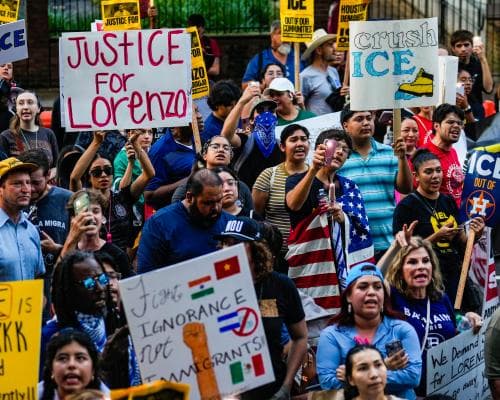
More than a hundred people packed the city council chamber on Tuesday, spilling into the hallways, their voices rising above the marble and mahogany. Outside, on the plaza, the chant was simple and devastating: “Do your job! Do your job!” They were not asking for much—just accountability for a death that, by every account, should never have happened. Maria Cervantes, who immigrated from Mexico and grew up in the East End neighborhood where Salgado Araujo was shot, put it plainly: “ICE hunts us like animals. I can’t help but think, who’s next? Am I going to get a bullet to the head for being brown?” Her words landed like a punch in a room full of polished shoes and prepared statements.
Salgado Araujo was not a target. ICE has admitted as much. He was a business owner, a father of three, a man who employed other men from the same neighborhood—men who now have to find another ride to work. His truck, that white Ford, was not a getaway vehicle. It was a tool. A livelihood. A testament to the kind of striving that the American dream is supposed to reward. Yet in the split second of a trigger pull, it became a crime scene. The mayor, John Whitmire, has yet to say whether the city will launch an independent investigation. Silence, in this case, speaks louder than any press release.
This is not an isolated incident. The same week, in Maine, 26-year-old Joan Sebastián Durán Guerrero was killed in another encounter with law enforcement. Two young men, two states, two funerals—and a pattern that immigrant justice groups say is anything but random. For the organizers in Houston, Tuesday’s protest was not the beginning. It was the latest chapter in a story that started long before the current administration, in the street corners where day laborers gather before dawn, in the safety-planning sessions with local businesses, in the quiet terror of a knock on the door. The luxury of safety, it turns out, is not evenly distributed.
What does a man’s truck mean when he is no longer in it? For his children, it is the last place they saw him alive. For his crew, it is a reminder that the morning commute can end in a morgue. For the collectors and connoisseurs who read this desk, I ask you to consider this: the rarest commodity in America today is not a vintage Ferrari or a first-edition Patek. It is the assurance that a working man, driving a white Ford to a job site, will arrive. That his life is worth more than a mistaken glance. That a bullet does not decide his worth.
The market for justice, like any other, is driven by demand. And in Houston, the demand is deafening. The chants on the plaza, the tears in the council chamber, the quiet rage of a mother burying her son—these are the signals of a shift. The ultra-wealthy understand value. They understand that when a community is devalued, everyone loses. The question is whether the city’s leadership will recognize that the price of inaction is far higher than the cost of an inquiry. Lorenzo Salgado Araujo’s truck is still parked somewhere. His family is still waiting. And the rest of us—we are still watching, wondering if the next bullet has a name on it.
In the world of curated lives, we speak often of provenance, of heritage, of the stories behind the objects we treasure. But the most important story is the one we are living now. The one where a father’s work truck becomes a monument to a system that failed him. The one where a city demands not just answers, but accountability. The one where we ask ourselves: what are we collecting, really? If it is not justice, then what is the point of all this beauty?