The Billion-Dollar Lung: Why Canadian Wildfire Smoke Is the New Normal for Investors
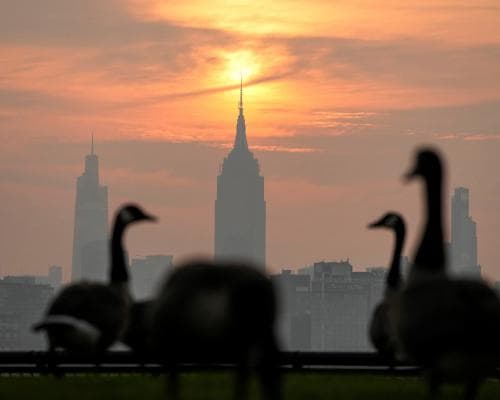
On Friday morning, the air quality index in Chicago hit 361—a level the government officially labels “hazardous.” That’s worse than Kinshasa. Worse than Nairobi. And it’s not a one-off. It’s the second major smoke event in two months, blanketing Detroit, Baltimore, Washington DC, and New York. For tens of millions of Americans, breathing has become a risk calculation. For the deep-tech and biotech investors watching this unfold, it’s a signal that a new market is crystallizing in real time.
This isn’t just a weather story. It’s a stress test for a $20 billion respiratory-health industry that has historically been reactive, not predictive. The smoke is exposing gaps in filtration technology, real-time monitoring, and personal protective equipment—gaps that are now being filled by a wave of startups and established players pivoting hard. Consider this: the global air purifier market is projected to hit $30 billion by 2028, according to Allied Market Research. But that’s just the surface. The deeper play is in biotech—specifically, in how we measure and mitigate the biological and chemical cocktail that wildfire smoke delivers to human lungs.
The technology shift is already underway. NASA’s Fire Information for Resource Management System (FIRMS) is tracking these fires from space, but the data is often hours old. A new crop of startups—like Airly, Clarity Movement, and Plume Labs—is deploying low-cost, hyperlocal sensor networks that update in minutes. They’re using AI to predict smoke plumes and issue personalized alerts. Meanwhile, companies like ResMed and Philips are integrating these feeds into their respiratory devices, creating a closed loop: smoke detected → inhaler dosage adjusted. That’s the kind of real-time biotech feedback loop that venture capital is betting on. In the first half of 2023 alone, air-quality-focused startups raised over $800 million, according to PitchBook data.
The capital is flowing, but the competition is fierce. On one side, you have legacy filtration giants like 3M and Honeywell, whose N95 respirators are suddenly in demand again—the Michigan Department of Environment just recommended N95 or P100 masks for outdoor exposure. On the other, you have a wave of D2C brands like Molekule and Dyson pushing smart purifiers with HEPA filters and real-time particulate displays. The wildcard is biotech: companies like Airthings and uHoo are now adding VOC and CO2 sensors that can detect the specific chemical signatures of wildfire smoke—like benzene and formaldehyde—that standard filters miss. The winner won’t be the one with the best hardware; it will be the one that owns the data layer connecting air quality, health outcomes, and insurance premiums.
This matters because the smoke isn’t going away. Canada’s wildfire season is starting earlier and burning longer, driven by a warming climate that dries out forests. The Northwest Territories are still burning deep. For investors, this is a structural shift, not a cyclical one. The market for “climate adaptation” technologies—things that help humans survive the new normal—is expected to exceed $2 trillion by 2030, according to McKinsey. Respiratory health sits at the intersection of biotech, climate tech, and consumer hardware, and it’s currently under-penetrated. The billionaires who are quietly placing bets here—think Jeff Bezos’s Bezos Earth Fund backing wildfire resilience, or Bill Gates’s Breakthrough Energy Ventures funding next-gen filtration materials—are betting that the lung will be the next frontier of personalized medicine.
So what happens next? The smoke will clear in a day or two. But the market it has revealed will not. Expect to see a wave of SPAC mergers in the air-purification space, more FDA-cleared smart inhalers, and a push for federal subsidies for home filtration systems—similar to what happened with solar panels. The smart money is already moving from reactive cleanups to predictive biotech. The question is whether the rest of the world will catch up before the next plume arrives.