The Hay Wain Reimagined: A Masterpiece for the Climate Age
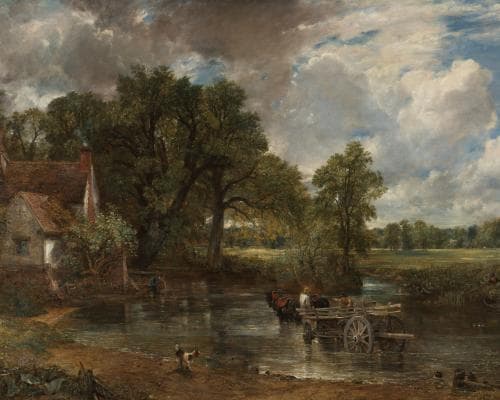
The first time I saw John Constable's *The Hay Wain*, it was a postcard—cruise missiles stacked in the wooden cart, pointing skyward. Peter Kennard's anti-nuke photomontage was a punk provocation, one of many parodies that have haunted this 1821 painting of an eternally rustic Britain. A few months ago, a newspaper cartoon showed an Iranian ballistic missile streaking through Constable's clouds. But when I visited Ipswich this summer, the climate itself delivered the punchline. Inside Christchurch Mansion, the exhibition *Walking Constable's Landscape* hangs the original masterpiece in a Tudor room, its grey and blue clouds dappling painted Suffolk fields with shade. Outside, the real grass was straw-yellow. The River Stour valley—Constable's birthplace and lifelong muse—looked blowtorched by drought. Global heating is not another joke on this comforting, Little English vision. It is a liberation. It forces us to see the painting's scale and ambition anew, not as a postcard of a lost Eden, but as a document of obsession, weather, and the fragility of place.
Christchurch Mansion is an unlikely but perfect stage for this reencounter. Usually housed in the National Gallery, *The Hay Wain* here hangs among a fine collection of Constables and works by fellow local hero Thomas Gainsborough. The intimacy changes everything. You can stand close enough to see the brushstrokes of the dog barking at the cart, the precise dampness of the clouds. The subtitle *Walking Constable's Landscape* is deliberately misleading: there is no walking involved unless you take a side trip to Dedham Vale. Instead, the show traces Constable's own walks and reveries through drawings and watercolours. It is a meditation on how a painter's daily perambulations—through fields, along the Stour, under shifting skies—become a lifelong conversation with light and mortality. For the discerning traveller, this is the antithesis of a curated escape. It is an invitation to slow down, to walk without destination, to let a landscape imprint itself on your consciousness.
The access here is the real luxury. Christchurch Mansion is a free public museum, but the experience of seeing *The Hay Wain* in its provincial home—surrounded by the actual topography that inspired it—is rarer than any private viewing. The exhibition runs through autumn, and the smartest move is to book a stay at a Suffolk country house like Hintlesham Hall or the Swan at Lavenham, then spend a day in Dedham Vale. Walk the footpaths Constable knew. Feel the heat that is rewriting his temperate palette. The irony is that the very climate crisis threatening this landscape has made it more urgent, more beautiful, more worth protecting. For those who have seen everything, this is a pilgrimage to the source of a cliché—and a revelation of its truth.
What does this signal about luxury travel now? The ultra-wealthy are moving beyond the obvious: not just private jets to remote islands, but a hunger for meaning, for provenance, for the story behind the image. Constable's *Hay Wain* has been so reproduced, so parodied, that it became invisible. This exhibition makes it visible again, not as a relic but as a living argument about nature, industry, and time. The cart in the painting is carrying hay, yes—but also the weight of a world that is heating, changing, vanishing. To stand before it in Ipswich, then walk out into a drought-stricken field, is to understand that the most profound luxury is attention. Attention to a cloud. To a season. To a painting that, two centuries on, is still teaching us how to see.
Where do the wealthy go next? Not to the Maldives or the Alps, but to the overlooked corners of heritage England—Suffolk, Norfolk, the Lake District—where art and climate converge. The new luxury is slowness, scholarship, and the courage to confront beauty in crisis. Constable's landscapes are not static; they are weather events. And in this age of extremes, they have never been more alive. The exhibition is small, but its implications are vast. It suggests that the next great travel experience is not a destination but a way of looking—at a painting, at a river, at a sky that might never look the same again.