The Art of Dislocation: Phoebe Bridgers and the Luxury of Unflinching Feeling
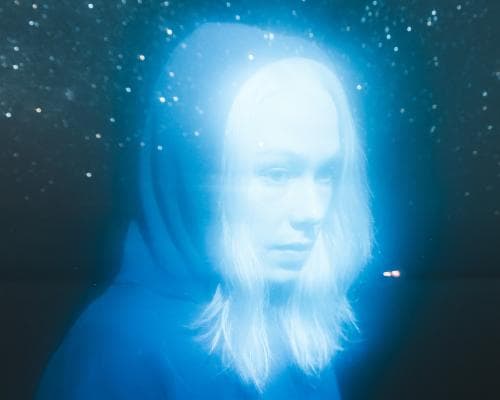
There is a particular thrill in watching an artist dismantle herself in public, especially when she does it with the kind of exquisite control that most of us reserve for choosing a wine. Phoebe Bridgers' new album, Lost Weekend, arrives six years after Punisher, and it opens with a scene of triumph—a crowd-surf at an Ohio gig, a fist raised in victory. But then the vocoder descends, and the acoustic guitar dissolves into static, and you realize the triumph is being watched from somewhere far away. It is a dislocation so elegantly rendered that it feels less like a confession and more like a private viewing of a very expensive, very broken mirror.
The album's title track, and the record as a whole, orbits two gravitational pulls: the death of her father, with whom she shared a strained history, and the end of her very public romance with actor Paul Mescal. Bridgers has always dealt in emotional excavation, but here she refines the craft to a kind of haute couture of feeling. The songs are tailored, precise, and unafraid of showing their seams. Dedicated “For Dad,” the album is not sentimental—it is honest, which is far rarer and far more valuable. In a world where luxury has become synonymous with distraction, Bridgers offers the opposite: the luxury of staying in the room with your own discomfort.
What makes Lost Weekend so remarkable is its construction. Bridgers, along with her collaborators, has built a sonic environment that mirrors the psychological state of its narrator. The music shifts between sweet fingerpicked figures and ambient noise, between clarity and obliteration, as if the listener is flipping through a series of perfectly composed photographs that keep blurring at the edges. This is not accidental. It is the work of an artist who understands that true craftsmanship lies in the details—the way a harmony can feel like a hand on your shoulder, the way a pause can say more than a chorus. The vocoder, which smothers her voice on “The Outside,” is not a gimmick; it is a deliberate smudge on the lens, a reminder that even our most vivid memories are mediated by distance.
For collectors, Lost Weekend is more than an album; it is a cultural marker. Bridgers has spent the past few years ascending from indie darling to mainstream phenomenon—Boygenius won three Grammys, her collaboration with SZA took another, and she has lent her voice to Taylor Swift, Lorde, and Paul McCartney. Yet this record feels like a deliberate step away from that trajectory, a return to the quiet, uncomfortable places where her best work lives. It is the kind of release that will be discussed in the same breath as the great breakup albums and the great grief albums, but it resists easy categorization. It is simply, devastatingly, hers.
In the market of taste, there is a growing appetite for authenticity—not the performative kind, but the sort that requires genuine risk. Bridgers has always traded in that currency, but Lost Weekend feels like her most audacious bet yet. It asks the listener to sit with dislocation, to find beauty in the static. For those who have followed her career, it is a confirmation of what they already suspected: that her genius lies not in the spectacle, but in the space between notes, where the truth lives.
As the year unfolds, Lost Weekend will undoubtedly be parsed, praised, and perhaps even mourned by those who see themselves in its fractures. But for now, it stands as a reminder that the most luxurious thing an artist can offer is not escapism—it is the courage to stay present, even when being present hurts. Bridgers has given us a record that does not flinch. In a culture that increasingly rewards the opposite, that is the rarest commodity of all.