The Apology That Mattered: Inside the Police Leader’s Fight to Rebuild Trust with Sydney’s Jews
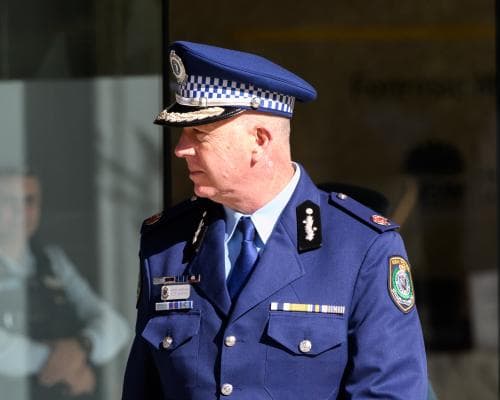
It was a Tuesday morning when the room went quiet. Acting Deputy Commissioner Peter McKenna, a man who has spent decades in the upper ranks of New South Wales police, sat before the royal commission into antisemitism and social cohesion and did something rare in public life: he admitted fault. Not a qualified apology. Not a deflection. A plain, human, “we failed you.” The failure was specific — police had been told more than a week in advance that members of the White Australia party, a group with neo-Nazi ties, planned to protest outside NSW parliament in November 2025. They chanted Hitler Youth slogans and held a banner reading “Abolish the Jewish Lobby.” Yet no one in the Jewish community was warned. McKenna’s apology was not just for the oversight, but for the fear that oversight caused.
McKenna is not a philanthropist in the traditional sense. He does not write checks or endow buildings. But in a moment when institutional trust is fraying, his willingness to stand up and say “we were wrong” may be the most valuable form of giving there is: the giving of accountability. The Jewish community in Sydney has long lived with a quiet vigilance — synagogues with security guards, schools with locked gates, community leaders who know the names of every hate group operating in the city. When police failed to alert them to the November protest, they were left exposed. Not physically — officers were present at the demonstration — but psychologically. The community was blindsided, and that shock reverberated far beyond the day itself.
McKenna’s testimony revealed the mechanics of the failure. There was a procedure, he said, a system in place to inform senior Jewish leaders of planned protests. It simply did not fire. “Human error,” he called it. But he did not stop at the apology. He told the commission that police have “put systems in place since to make sure that did not happen again.” That is the quiet, unglamorous work of repair — not just saying sorry, but building the guardrails so that sorry becomes unnecessary. It is a lesson that extends far beyond policing: in philanthropy, in activism, in any effort to protect the vulnerable, the real test is not the grand gesture but the reliable infrastructure that makes harm less likely.
The broader context is stark. Antisemitism in Australia has risen sharply in recent years, tracking global trends. The royal commission itself is a response to that rise, and McKenna’s testimony is part of a larger reckoning. He acknowledged that police were “very cognisant” that the White Australia party is “linked to, if not self-proclaiming to be, neo-Nazis, white supremacists, racists.” Yet they allowed the protest to proceed because they found no legal grounds to stop it. That is a difficult line — between free expression and public safety — and McKenna did not pretend to have easy answers. But his candor about the limits of the law, and the need for better communication, is exactly the kind of honesty that builds trust.
What does this mean for the culture of giving? It suggests that generosity is not only about money. It is about attention, about care, about the decision to treat another community’s safety as your own responsibility. McKenna’s apology was a gift — an acknowledgment that the Jewish community deserved better, and that the police, as an institution, are accountable to them. It is the kind of giving that does not make headlines for its scale, but for its sincerity. And in a world where trust is the scarcest resource, that sincerity is priceless.
The systems McKenna says are now in place are not visible to the public. There will be no ribbon-cutting, no plaque. But for Sydney’s Jewish families, the knowledge that police are now more likely to call, to warn, to share information — that is a form of protection that money cannot buy. And for anyone watching, the lesson is clear: true philanthropy is not about the size of the gift, but the depth of the commitment. McKenna’s commitment, on that Tuesday, was to say the hardest words in any institution: “We were wrong. We are sorry. We will do better.” That is a legacy worth more than any endowment.