The Flag of Solidarity: How Spain’s World Cup Victory Became Gaza’s Celebration of Resistance
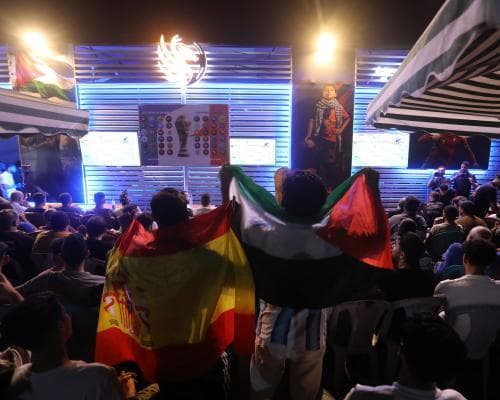
In a world where the ultra-wealthy collect yachts, vineyards, and private islands, the most coveted possession this summer was something far more fragile: a flag. Not just any flag, but the red-and-gold banner of Spain, waved in the rubble-strewn streets of Gaza. When the Spanish national team lifted the World Cup trophy, it wasn’t just Madrid that erupted. It was Gaza City, Khan Younis, and Rafah. The image of a young boy in a dusty camp holding a Spanish flag, his face lit by the glow of a shared television, is the kind of visual that no amount of money can buy. It is a reminder that the most powerful luxury is meaning.
This was no ordinary football match. The Spanish team had become an unlikely vessel for a political statement that resonated far beyond the pitch. Spain, among Europe’s most vocal critics of Israel’s war on Gaza, had turned the tournament into a referendum on human rights. For Palestinians, supporting Spain was not about tactics or star players—it was about recognition. The teenage prodigy Lamine Yamal, who had raised a Palestinian flag during Barcelona’s La Liga celebrations in May, became a folk hero in Gaza. “Whoever raises the Palestinian flag deserves to raise the World Cup,” wrote the Gaza al-Irada amputee football team in a pre-game video. In a place where limb loss is a daily reality, that message carried the weight of a manifesto.
The craftsmanship here is not in leather or carbon fiber, but in the weaving of a narrative. Spain’s prime minister, Pedro Sánchez, defended Yamal after Israel’s defense minister accused the player of “inciting hatred.” Sánchez posted: “Lamine has only expressed the solidarity with Palestine that is felt by millions of us in Spain. Another reason to be proud of him.” That kind of political cover is rare. It is the equivalent of a maison de haute couture defending a controversial design against a government censor. The result? A surge of grassroots support that turned a sports event into a global statement. In Gaza, cafes and outdoor screenings became cathedrals of defiance, where the risk of Israeli airstrikes was outweighed by the need to witness a small victory for justice.
For collectors of rare experiences, this is the ultimate piece: a moment where sport, politics, and human dignity converge. The market for such moments is, by definition, exclusive. You cannot buy a ticket to this story. You cannot charter a jet to witness it. The price of admission is a willingness to stand with the marginalized. Israel’s prime minister, Benjamin Netanyahu, had backed Argentina, posting a good luck message for Lionel Messi’s team. The Palestinian delegation to the United Nations responded with an image of a Palestinian flag superimposed over the World Cup trophy. The contrast could not be starker: one side backed by a far-right alliance, the other by a spontaneous uprising of the human spirit.
What does this signal about luxury taste? It suggests that the most discerning among us are no longer satisfied with mere objects. They crave narratives that matter. They want their champagne to come with a conscience, their travel to leave a footprint of empathy, their collections to tell stories that challenge the status quo. The Gaza-Spain connection is a masterclass in brand alignment—not for profit, but for principle. It is the kind of story that makes a $50,000 watch feel hollow if it does not come with a backstory of courage.
Looking forward, this is not a fleeting trend. It is a paradigm shift. The ultra-wealthy are increasingly seeking investments in solidarity—whether through philanthropic foundations, art that speaks to social justice, or simply by choosing which football team to support. The Spanish victory in Gaza has shown that the most valuable asset in a fractured world is the ability to stand for something. And for those who can afford to choose, the choice has never been clearer: the flag you wave matters more than the car you drive. In the end, the true luxury is being on the right side of history.