The Golden Quadrant: Rodri Joins Football’s Most Exclusive Collectors’ Club
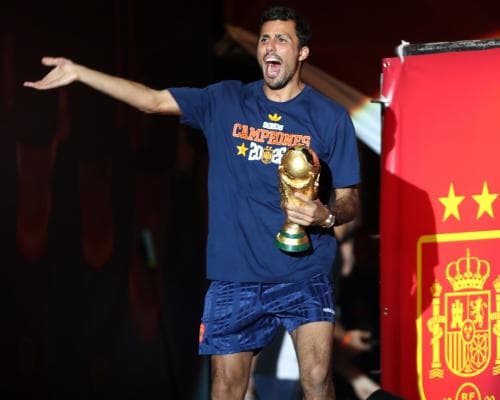
On a warm July evening in Berlin, Rodri lifted the World Cup trophy and, in that single gesture, completed a collection that only seven men before him have ever assembled. It is not merely a win. It is the acquisition of a quadriptych so rare that the ultra-wealthy collectors of the sporting world—those who understand provenance and completeness—immediately recognized its significance. Rodri now possesses the Ballon d’Or, the Champions League, the European Championship, and the World Cup. In the language of fine art, he has hung a Rothko next to a Richter, a Basquiat, and a Hockney on the same wall.
The first to complete this set were Franz Beckenbauer and Gerd Müller, who did it on the same day in 1974, when West Germany beat the Netherlands. Beckenbauer, the elegant sweeper, and Müller, the predatory striker, had already won the European Cup with Bayern Munich and the European Championship with Germany. Müller had taken the Ballon d’Or in 1970; Beckenbauer followed in 1972. They were the original owners of the golden quartet. For nearly three decades, no one else could match them. Then came Zinedine Zidane, who in 2002 added the Champions League to his 1998 World Cup, 1998 Ballon d’Or, and 2000 European Championship—and he did it with that volley, the one that still hangs in the Louvre of football memories.
Rivaldo joined the club in 2003, though his Milan Champions League medal came with a footnote: he was an unused substitute in the final against Juventus. Still, he had played through the competition, and the medal counts. Ronaldinho’s inclusion carries a similar asterisk—he was an unused sub in Brazil’s 1999 Copa América final—but his 2002 World Cup, 2005 Ballon d’Or, and 2006 Champions League with Barcelona are indisputable. Lionel Messi, predictably, holds the full set, his Champions League titles with Barcelona bookending his 2022 World Cup, 2021 Copa América, and multiple Ballon d’Ors. The list is so short that it feels less like a leaderboard and more like a numbered edition of a limited-release timepiece.
For collectors, rarity is everything. A single trophy is a conversation piece. Two is a theme. Four, when they are the four most coveted titles in the sport, is a legacy. The market for such achievements is not measured in dollars but in prestige, though the financial implications are real: Rodri’s market value, endorsement potential, and future earnings have all ascended into a stratosphere that few athletes ever reach. He is now a blue-chip asset, the kind of player that clubs and brands treat as a generational investment. In the world of ultra-luxury, where provenance and completeness drive value, Rodri’s career has become a masterpiece.
What does this tell us about the taste of the ultra-wealthy? They do not chase single successes. They seek the full set—the complete collection that signals not just wealth but discernment, patience, and an eye for the long game. A man who owns a single Patek Philippe is rich. A man who owns the entire Calatrava series from 1932 to 1970 is a connoisseur. Rodri’s achievement is that connoisseur’s dream: a career that has touched every peak, leaving no summit unclimbed. It is the difference between a wine cellar with a single Château Margaux and one with every vintage from 1945 to the present.
Looking ahead, the question is not whether Rodri can add more—he is only 28, and more Champions Leagues and Ballon d’Ors are plausible—but whether anyone else can join this club. Kylian Mbappé, Jude Bellingham, and Erling Haaland are all chasing the same four trophies, but they remain one or two pieces short. For now, Rodri’s collection is complete. In the hushed galleries of football’s elite, his name is now engraved alongside the immortals. And for those who understand the value of a perfect set, there is nothing more covetable.