The Hidden Masterpiece: Why the Bayeux Tapestry’s Anglo-Saxon Stitchers Were the True Artists
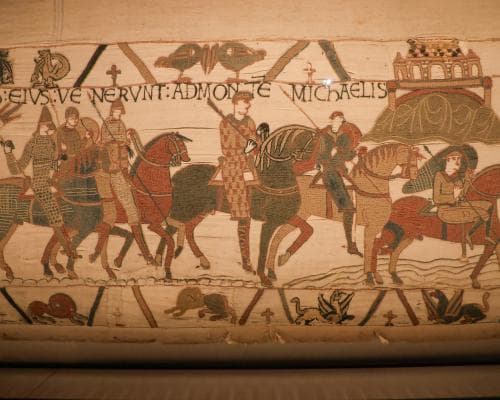
Imagine owning a piece of silk that took a dozen women a year to stitch — and then learning they were forced to make it by a conquering warlord. That is the story behind the Bayeux Tapestry, the most famous medieval artwork in the Western world. But here is the surprise that changes everything: those women were almost certainly Anglo-Saxon, not Norman. Their husbands may well have died at the Battle of Hastings. And the needlework they produced was so exquisite that it had been celebrated across Europe for decades before 1066. It was called Opus Anglicanum — English work. And it was the finest embroidery the continent had ever seen.
Let’s sit with that for a moment. The Bayeux Tapestry, that 230-foot-long chronicle of William the Conqueror’s victory, is not a Norman trophy. It is a forced tribute, stitched by the very people the Normans had just defeated. The women of Kent, heirs to a tradition of needlework that had made English embroidery the envy of popes and kings, were compelled by Odo of Bayeux — William’s half-brother and the man who likely commissioned the tapestry — to create this masterpiece under duress. The compulsion, the coercion, the sheer brutality of Norman rule in England: it is all woven into those linen threads. And yet, the art itself is so breathtaking that for centuries we have mistaken it for a celebration of the conquerors.
Now, consider the craftsmanship. Opus Anglicanum was not just embroidery; it was a lost luxury technology. Using silk thread, gold wire, and split-stitch techniques that created an almost three-dimensional texture, English embroiderers produced vestments and hangings that were traded from Rome to Constantinople. A single piece could take years to complete, using materials so precious that they were often listed in royal inventories alongside jewels. The Bayeux Tapestry, despite its name, is not a tapestry at all — it is an embroidery. And its makers were not anonymous laborers; they were the most skilled artisans in medieval Europe, working under duress but with a mastery that no Norman could replicate.
What does this tell us about wealth and taste today? It tells us that the most valuable things are often the ones with a hidden story — a story of resistance, of beauty born from oppression, of a culture that refused to be erased. For the ultra-wealthy collector, a medieval manuscript or a piece of Opus Anglicanum is not just an object; it is a fragment of a lost world where craftsmanship was the ultimate status signal. In an age of mass-produced luxury, owning something that took a human being years to make — and that carries the weight of a conquered people’s dignity — is the rarest kind of possession. It signals not just money, but discernment. It says: I understand that true power lies in the hands of the maker, not the conqueror.
And here is the forward-looking truth: the market for medieval art is quietly booming. Sotheby’s and Christie’s have seen record prices for illuminated manuscripts and early English textiles. Private collectors are snapping up pieces that once hung in cathedrals, and museums are scrambling to acquire anything with a provenance linking it to the Anglo-Saxon era. Why? Because in a world of digital everything, the tangible, the handmade, the historically charged object is the ultimate hedge against meaninglessness. The Bayeux Tapestry itself is not for sale — it lives in a museum in Normandy — but its legacy is. Every piece of Opus Anglicanum that surfaces at auction is a reminder that the best art is never neutral. It is always a story of who made it, and why.
So the next time you walk into a cathedral or a castle, look closely at the stonework, the embroidery, the stained glass. Ask yourself who really made it. The Normans gave us castles and cathedrals, yes. But the hands that did the work — the Anglo-Saxon hands that stitched the Bayeux Tapestry — they were the ones who turned stone and thread into art. And that, my friends, is the kind of heritage worth not just seeing, but owning.
The Experience
For a private consultation on acquiring a piece of Opus Anglicanum or a medieval manuscript, contact our heritage acquisitions desk. A curated viewing of the Bayeux Tapestry itself can be arranged through a bespoke tour with a specialist historian.
More in ENTERTAINMENT