The Billionaire Who Broke Washington: Elon Musk’s Confession, His Cosmic Bet, and the End of Money
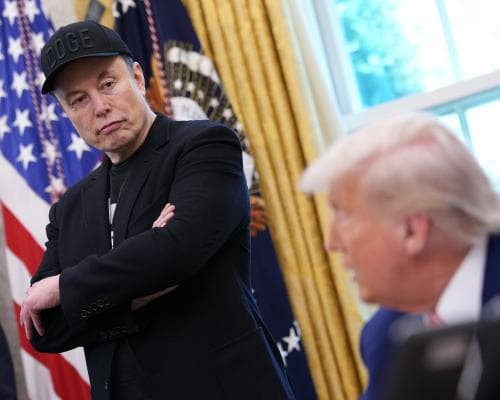
The world’s richest man—briefly its first trillionaire—sat in a Texas Tesla factory and said the quiet part out loud. “I got carried away,” Elon Musk told the Economist, referring to his volatile alliance with Donald Trump and his reign as the president’s financial axman. For those who track the intersection of extreme wealth and raw power, this was not a mea culpa. It was a confession from a man who touched the third rail of politics and lived to tell the tale.
Musk helped elect Trump in 2024 with $200 million of his own money. Then he ran the so-called Department of Government Efficiency—Doge, in the irreverent shorthand of the internet—slashing $150 billion in federal spending and forcing tens of thousands of workers out of their jobs. He was the wrecking ball. And for a moment, he loved it. But in a 90-minute interview recorded at a Tesla plant in Texas, Musk admitted the dalliance with Washington’s levers of power consumed him. “Instead of doing Doge, I would have basically worked on my companies,” he said on a podcast in December. Now, with his SpaceX floatation in June briefly pushing his net worth past $1.25 trillion before settling back to a relatively penurious $750 billion, he’s refocusing on something far bigger than politics: the end of work itself.
Musk’s predictions are the kind that make a private-jet setter pause mid-sip of a 1982 Romanée-Conti. Within five years, he says, artificial intelligence systems may surpass the sum of all human intelligence. Within ten years, robots in the workplace will usher in an era of such “amazing abundance” that money will become meaningless. He’s not being poetic. He’s building it. His AI venture is merging with SpaceX to develop systems that can perform cognitive tasks like software programming, while Tesla manufactures humanoid robots. The datacenters powering this? They’ll be in space—a plan experts have called “catastrophic” for Earth. Musk, ever the Cassandra, shrugs. “People don’t realize that what I’m saying will come to pass,” he told the Economist, his voice carrying the confidence of a man who has already moved from “exhilaration to terror” in a single day—not over a stock price, but over the AI he believes will render human labor optional.
This is the rare moment when a titan of industry drops the corporate veneer and speaks like a philosopher-king with a balance sheet. Musk’s political views remain contentious—he still holds them, even after admitting he got carried away. But what he’s really signaling is a shift in how the ultra-wealthy think about legacy. For decades, the pinnacle of status was a private island or a yacht that could host a G7 summit. Musk is betting that the true luxury of the future won’t be a thing—it will be freedom from the concept of money itself. He’s not buying art. He’s building the machines that will make art, and everything else, abundant beyond price.
For the billionaires who read this, the takeaway is not about politics. It’s about where to place a bet. Musk’s SpaceX floatation minted a trillion-dollar moment. His AI venture promises a world where the phrase “cost is no object” becomes literal. The question is not whether he’s right—it’s whether you’re positioned for the aftermath. The man who broke Washington is now trying to break the economic order. And he’s inviting you to watch, from the front row, as the future makes its entrance.
The Experience
Secure your seat at the next private roundtable with frontier-tech founders through our concierge—because the future is best understood before it arrives.