The AI Apocalypse That Wasn't: Why the Smartest Money Is Betting on Human Capital
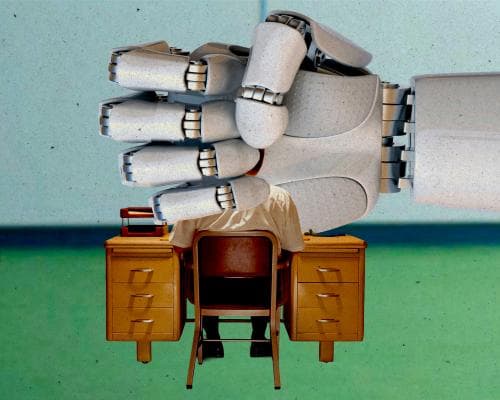
In the gilded boardrooms of Silicon Valley, the prophecy was delivered with the certainty of a Swiss timepiece: artificial intelligence would decimate the white-collar workforce. Anthropic's Dario Amodei predicted half of all entry-level jobs would vanish. OpenAI's Sam Altman foresaw the end of entire job categories. The headlines screamed, the pundits nodded, and a generation of anxious graduates reconsidered their majors. But a year later, the great carnage has failed to materialize. The revolution, it seems, is not being televised—it's being quietly integrated into the fabric of the modern enterprise, and the wealthy are taking note.
For those who measure success in portfolio diversification and legacy building, the real story is not about job losses but about the evolution of value. The Stanford Institute for Economic Policy Research recently crunched the numbers, and they are as surprising as a vintage wine tasting well past its prime. Since ChatGPT's 2022 debut, unemployment among the 20% of workers most exposed to AI actually rose less than among the least exposed—0.77 percentage points versus 0.85. Meanwhile, new graduate unemployment hovers at 5.6%, a figure that sounds alarming until you factor in the hangover from pandemic-era overhiring and the lingering allure of remote work. The mass extinction event, it turns out, is a myth.
What's actually happening is far more subtle, and far more interesting. AI is not replacing the workforce; it's redefining the job description. It's consolidating roles, automating the mundane, and raising the bar for entry. A recent ZipRecruiter survey found that 74% of employers now view AI skills as a strong advantage, with 13% demanding them company-wide. This is not the death of human capital—it's the elevation of it. The ultra-wealthy, who have always understood that scarcity drives value, see this as a golden opportunity. The ability to harness AI, to work alongside it, to deploy it as a force multiplier, is becoming the new luxury skill. It's the difference between owning a classic car and driving a modern hypercar—both are status symbols, but only one is future-proof.
The craftsmanship angle here is not about leather or gold, but about the art of adaptation. Just as the computer revolution took decades to fully transform labor markets, as Stanford fellow Erika McEntarfer notes, AI is a slow burn, not a wildfire. The economists who predicted chaos were looking at the wrong metrics. Government statistics, by their nature, lag behind reality. Private data is fresher but fragmented. The truth is that we are in the early innings of a transformation that will reward those who can navigate the ambiguity. For the 1%, this means investing in people who can think critically, who can leverage AI as a tool rather than fear it as a rival. It's a shift from hiring for tasks to hiring for potential—a more exclusive, more discerning approach to talent acquisition.
This is the new marker of wealth: not just owning the technology, but mastering its human interface. The CEOs who once predicted doom are now softening their language, speaking of AI as an augmenter, not a replacement. They recognize that the real value lies in the synergy between human intuition and machine efficiency. For the luxury market, this signals a shift in what we collect—not just objects, but capabilities. The future belongs to those who can curate their teams the way they curate their art collections: with an eye for rarity, a respect for craft, and a willingness to pay a premium for excellence.
So, what does this mean for the discerning reader? The AI apocalypse was a mirage, a mirage that obscured a more profound truth: the future of work is not about survival, but about distinction. The jobs that remain will be more demanding, more nuanced, and more rewarding. The entry-level positions that were supposed to vanish are being reimagined as apprenticeships in a new kind of luxury—the luxury of adaptability. As the dust settles, the smartest money is not on the technology itself, but on the humans who can dance with it. And that, my friends, is the ultimate status symbol.
The Experience
To position yourself at the forefront of this shift, consider a private consultation with a leading AI talent strategist, or enroll in an executive program at a top-tier institution that focuses on human-AI collaboration.