Climate Denial 2.0: How the Right Is Rebranding Catastrophe as Comfort
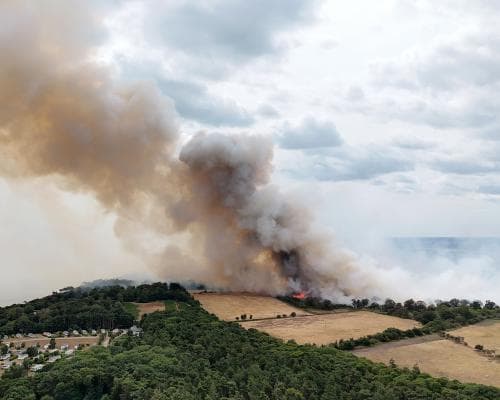
It’s the summer Britain never thought it would see. Half of England and all of Wales officially in drought. Wildfires tearing through the Cairngorms, Suffolk, and the Isle of Wight. Reservoirs running dry, farmers warning of food shortages, and the Royal Horticultural Society seriously considering moving its hydrangeas to cooler climes. The question on everyone's lips — when will it rain? — has become a national obsession. But if you’ve been reading certain parts of the British press, you might have come away with a very different story: that this is simply the new normal, a Mediterranean holiday we should learn to enjoy, and that the real problem isn’t the heat, but the 'catastrophism' of those who say we must act.
This is the new face of climate denial. It’s no longer about claiming the planet isn’t warming — the evidence is too visceral, too visible in the smoke-filled skies and the cracked earth. Instead, the strategy is subtler, more insidious. It’s a rebrand of surrender as pragmatism. A flurry of opinion pieces, largely in the Telegraph, have argued that Britain should abandon its net-zero targets and simply 'adapt' to a warmer world. They’ve suggested that environmental groups are to blame for the wildfires, by blocking controlled burns. And they’ve framed the very concept of climate crisis as a 'leftist weapon' designed to 'destroy capitalism'. This isn’t denial. It’s a strategic retreat, a way to maintain the status quo while the world burns around us.
The intellectual architect of this shift is a loose coalition of right-wing think tanks, fossil fuel apologists, and contrarian commentators. They’ve learned from the failure of flat-out denial. You can’t look at a reservoir that’s a cracked mudflat and say the climate isn’t changing. So they’ve moved the goalposts. The new narrative is one of fatalistic acceptance: if we can’t stop it, why ruin the economy trying? It’s a message that resonates with a certain strain of conservative thought, one that prizes short-term economic stability over long-term existential risk. But as Bob Ward, policy and communications director at the Grantham Research Institute, points out, this is a deliberate distortion of the science. The 'adaptation' they speak of isn’t about building flood defenses or developing drought-resistant crops — it’s about giving up on mitigation altogether.
The stakes here are enormous, and not just for Britain. This isn’t a fringe debate confined to the letters page of a right-wing newspaper. It’s a global phenomenon. We’re seeing the same playbook in the United States, where certain billionaires and tech moguls are funding climate-skeptic think tanks while simultaneously building luxury bunkers in New Zealand. It’s a cynical bet that the world will burn, but that the rich will be fine — so why bother with the messy, expensive business of transitioning to clean energy? This is the 'billionaire bet' on chaos, a quiet wager that adaptation means survival for the few, not the many. And it’s a bet that threatens to undermine the fragile consensus that has driven the Paris Agreement and the global push for net zero.
The market, however, tells a different story. While the Telegraph editorializes against climate action, the world’s most sophisticated investors are pouring billions into renewable energy, electric vehicles, and carbon capture technologies. In 2025, global investment in the energy transition hit a record $1.8 trillion, according to BloombergNEF. The smart money is betting on a green future, not a scorched one. The contradiction is stark: the same voices that decry 'catastrophism' are the ones who stand to profit most from the catastrophe. They’re not just denying the science; they’re denying the economics. They’re peddling a narrative of hopelessness that directly contradicts the very real, very lucrative innovations that are already decarbonizing our economies.
So what does this new form of denial signal for the sector? It signals that the battle is no longer about the science — it’s about the story we tell ourselves about the future. It’s a battle for the narrative. The 'adaptation' gambit is a way to make climate inaction feel reasonable, even virtuous, to a public that is exhausted by doom and gloom. But it’s a false comfort. As the Grantham Institute’s Bob Ward notes, the public overwhelmingly supports more action on climate, not less. The challenge for innovators, policymakers, and communicators is to offer a more compelling story — one of resilience, opportunity, and collective action, not just survival. We need to make the future of a green economy feel more tangible, more exciting, and more possible than the future of a scorched planet.
This is the real fight ahead. It’s not about whether the planet is warming — that debate is over. It’s about whether we will allow a vocal minority to convince us that the only rational response is to give up. The answer, I believe, lies in the very technology and capital that is already reshaping our world. From ultra-efficient solar panels to next-generation nuclear reactors, the tools to build a better future are here. The question is whether we have the collective will to use them, or whether we let the new deniers — the 'adaptationists' — win by default. Because the next heatwave is coming. And the one after that. The only question is whether we’ll be ready to fight, or just learn to live with the ashes.