The Hormuz Precedent: How Precision Strikes Are Rewriting the Rules of Naval Warfare
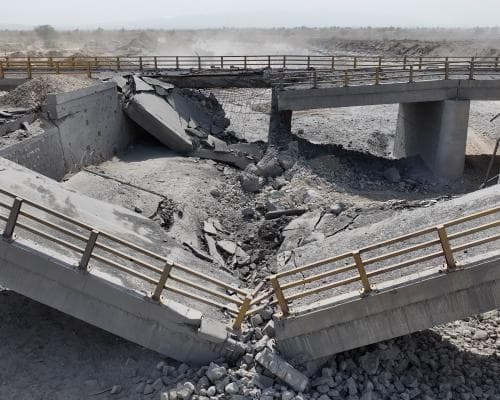
The seventh night of US strikes on Iran was not just another volley in a long-simmering conflict. It was a live demonstration of a new military doctrine — one that treats the Strait of Hormuz not as a passive waterway, but as a dynamic, contested battlespace where energy, data, and precision munitions collide. When US Central Command announced at 7pm GMT that it was "continuing to degrade Iranian military capabilities," it wasn't just issuing a press release. It was telegraphing a strategic shift: sustained, nightly operations designed to dismantle an adversary's infrastructure, not just retaliate.
This is the kind of conflict that defense tech investors have been modeling for years. The strikes hit bridges in Hormozgan province, a tower in Chabahar port, and electrical infrastructure so precisely that Iran's energy ministry had to beg citizens to ration air conditioning. The message is clear: modern warfare is increasingly about controlling energy grids, data centers, and logistics nodes — not just tanks and aircraft carriers. For the deep-tech crowd, this is the thesis playing out in real time. Palantir, Anduril, and a host of AI-driven defense startups have been building tools for exactly this scenario: persistent surveillance, autonomous targeting, and infrastructure-level disruption.
But the real story is the escalation of counter-claims and asymmetric responses. Iran's Islamic Revolutionary Guard Corps claimed it struck a US combat aircraft base in Bahrain, an intelligence datacenter in Kuwait, and a naval fuel pier. The US military dismissed the tanker mine claims as false. This is the fog of war, but it's also the new battlefield of information warfare. Every explosion is now a data point — analyzed by satellite imagery, social media scraping, and AI models that can assess damage in near real-time. The companies that can synthesize this chaos into actionable intelligence are the ones that will define the next decade of defense contracting.
The Strait of Hormuz is the world's most critical energy chokepoint, with about 20% of global oil passing through it daily. A sustained conflict here doesn't just spike oil prices; it accelerates the search for alternative energy routes, naval drones, and undersea warfare systems. The US strikes on Bandar Abbas's bridges and Iranshahr airport are a bet on air supremacy and precision logistics. Iran's response — targeting a fuel pier and an intelligence center — is a bet on asymmetric disruption. Both sides are testing technologies that billionaires like Peter Thiel and Elon Musk have funded: directed energy weapons, autonomous sea drones, and hardened communication networks.
The market signal is unmistakable. Defense tech venture funding hit a record $35 billion globally in 2024, and this conflict will only turbocharge that trend. Startups focused on counter-drone systems, satellite-based ISR (intelligence, surveillance, and reconnaissance), and resilient energy grids are seeing inbound interest from sovereign wealth funds and Pentagon buyers alike. The US strikes on Iranian power infrastructure — forcing citizens to cut air conditioning in extreme heat — underscore a brutal reality: energy is a weapon, and the companies that can protect or disrupt it will be indispensable.
What happens next is not just a military question. It's a technology question. Can the US sustain nightly precision strikes without triggering a wider war? Can Iran's IRGC continue to strike at US assets without escalating to a full naval confrontation? The answer lies in the tools being built right now: autonomous loitering munitions, AI-targeting systems that can process satellite data in seconds, and cyber-physical attacks on power grids. This conflict is a stress test for the entire defense innovation ecosystem.
For the billionaires and elite capital betting on defense tech, Hormuz is the ultimate proof of concept. It shows that the future of warfare is not about bigger bombs, but about smarter, faster, and more sustained degradation of an enemy's ability to function. The seventh night of strikes is a preview of a world where every chokepoint — from the Taiwan Strait to the Suez Canal — could become a live-fire laboratory for the next generation of military technology. The question is not if this doctrine spreads, but who will build the tools to win under its rules.