The Billionaire's Table: A Georgian Soup Worth More Than a Lottery Win
Imagine being told that meeting a Georgian outside their homeland is rarer than winning the lottery. That’s the opening gambit in Leo Vardiashvili’s novel, *Hard by a Great Forest*, and it’s a line that should make any connoisseur of the world’s finest things pause. Because in the rarefied circles where true wealth circulates, rarity is the ultimate currency. And here, the prize isn’t a jackpot of cash—it’s an invitation to a table laden with 6,000 years of culinary wisdom, a feast known as a supra, where the host’s generosity is worth more than any offshore account.
With fewer than six million Georgians on the planet—and barely a thousand in all of Australia—this is a culture that has perfected the art of scarcity. Yet, as Alice Zaslavsky, whose family makes up a tiny fraction of that diaspora, reveals, what Georgians lack in numbers, they more than compensate for in hospitality. The supra is not just a meal; it’s a statement of abundance, a peasant-style spread of vegetable-laden dishes, cheesy breads, and wines from a country that practically invented the grape. For the ultra-wealthy, who can procure anything money can buy, the true luxury is access to something that cannot be ordered from a catalog—a living, breathing tradition that has survived millennia at the crossroads of Europe and Asia.
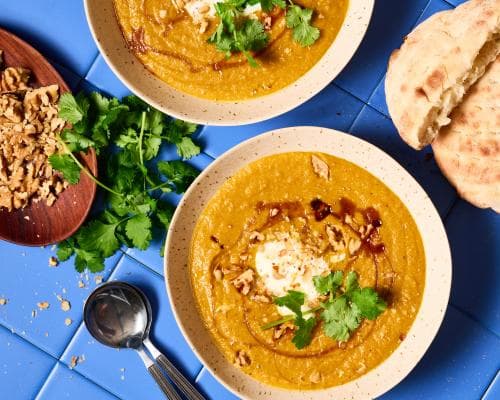
Zaslavsky’s recipe for Georgian-spiced carrot, sweet potato, and lentil soup is a masterclass in transposing rarity. In Tbilisi’s markets, you’d find the essential spices—utskho suneli (blue fenugreek), Imeretian saffron (ground dried marigold), and Svanetian salt—piled in vibrant, colorful mounds. But outside Georgia, these are elusive treasures, even for the most well-stocked pantries. The genius of Zaslavsky’s approach, inherited from her mother, is the art of the elegant substitution: a whisper of Keen’s curry powder standing in for khmeli suneli, a pinch of turmeric mimicking marigold’s golden glow. It’s a lesson in adaptability that speaks directly to the modern collector—sometimes, the most exquisite experience isn’t in owning the original, but in reimagining it with your own resources.
This soup, a spin on a family classic, swaps traditional red kidney beans for red lentils—a nod to the PhD students from the subcontinent who introduced them to her mother. It’s a dish that honors heritage while embracing innovation, much like a fine watchmaker who uses a modern movement inside a vintage case. The finishing touches—fresh walnuts, bought shelled to avoid rancidity, and a tang of pomegranate molasses—are features of Georgian kitchens that have now become staples in the pantries of the world’s most adventurous cooks, thanks to the likes of Yotam Ottolenghi and Claudia Roden. Every spoonful is a negotiation between the old and the new, a taste of a country that has remained tantalizingly out of reach for most.
For those who measure wealth in experiences rather than assets, this recipe signals a shift in taste. The luxury market has long been dominated by French châteaux and Italian fashion houses, but the discerning few are now turning to the hidden corners of the Caucasus. Georgia offers something that cannot be mass-produced: authenticity. It’s the thrill of discovering a wine that has been made in the same clay qvevri vessels for 8,000 years, or a spice blend that has never been commercialized. This soup is a gateway to that world—a world where the rarest thing isn’t a limited-edition Birkin, but an invitation to a supra, where the host will tell you that meeting you was better than winning the lottery.
As the global elite increasingly seek out the next undiscovered frontier, Georgia stands poised to become the new must-visit destination. The country’s winemaking tradition, its UNESCO-listed qvevri method, and its unspoiled landscapes are already drawing the attention of savvy investors and travelers. And for those who cannot yet book a private jet to Tbilisi, Zaslavsky’s recipe offers a taste of that exclusivity at home. It’s a reminder that true luxury isn’t about what you can buy—it’s about what you can experience, even if that experience begins with a humble pot of soup. So, take a page from the Georgian playbook: gather your closest friends, pour a glass of amber wine, and let the supra begin. Because in the end, the real jackpot isn’t money—it’s the stories you share and the flavors you remember.
The Experience
To taste this Georgian rarity for yourself, source the spices online or visit a specialty purveyor, then host your own supra-inspired dinner. For the full immersion, book a private culinary tour of Tbilisi’s markets and family-run wineries.