Mitch McConnell's Empty Chair Is a $500 Billion Problem for Markets
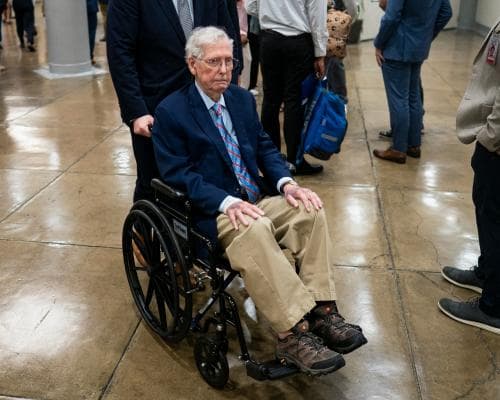
The most powerful man in American fiscal policy hasn't shown up to work in six weeks. And no one knows when he's coming back.
Mitch McConnell's office confirmed Monday that the 84-year-old Kentucky Republican is still not cleared to resume Senate duties after a fall at his home in mid-June left him hospitalized and briefly unconscious. The update, accompanied by a new photo, describes "intense physical therapy" and a senator who's "working hard" to return. But the key detail is what's missing: a timeline. For a man who has controlled the Senate calendar like a chessboard for decades, silence is the loudest signal.
Here's why that matters to anyone building or protecting serious capital. McConnell is not just any senator—he's the institutional memory of Senate procedure, the man who held the line on the debt ceiling in 2023, who shepherded the Tax Cuts and Jobs Act through in 2017, and who has personally blocked or advanced every major financial regulation for the last decade. His absence creates a vacuum in the chamber's most sensitive negotiations: the upcoming September budget fight, the continuing resolution to keep the government funded past September 30, and the quiet horse-trading on everything from SEC rulemaking to crypto legislation.
Let's get into the mechanics. The Senate operates on relationships and procedural know-how that no junior member can replicate overnight. McConnell's deputies—Senators John Thune and John Barrasso—are capable, but they lack his singular ability to read a conference room, twist arms, and count votes in his sleep. The 84-year-old has also been the GOP's leading fundraiser and strategic voice on judicial confirmations, which directly impacts regulatory enforcement and corporate litigation risk. Without him, the Republican conference is a ship without a captain during a storm.
The personal angle here is brutal and human. McConnell loves the Fancy Farm picnic—a Kentucky tradition of barbecue, mutton, and political barnstorming. He missed it this year for the first time in memory. "I hate that I'll miss the fun," he said in a statement. That's not political theater. That's a man who knows his body is failing him at the worst possible time. For a generation of investors who have bet on Washington gridlock as a stable backdrop, this is a reminder that the most important variable in political risk is biological.
What does this signal for markets? Uncertainty. The S&P 500 has been pricing in a benign political environment—low probability of a government shutdown, low probability of a debt-ceiling crisis, low probability of aggressive financial regulation. McConnell's prolonged absence increases the odds of procedural chaos. A continuing resolution could get hung up. The farm bill could stall. And the 2024 appropriations process, already behind schedule, could collapse into a shutdown fight without a seasoned negotiator to broker a deal.
For the wealthy, this is a portfolio risk that doesn't show up on a Bloomberg terminal. The smart money is already watching the VIX and Treasury yields for signs of Washington dysfunction. But the real signal is quieter: watch the Senate calendar. If McConnell is still absent by mid-September, start hedging. The most expensive mistake in wealth management is assuming that the people running the system will always be there to run it.
McConnell will likely return—he's tough, disciplined, and has survived worse. But the clock is ticking. Every day he's not in that chair is a day the markets are flying blind on the most important variable of all: political stability. For now, the smart capital is watching the rehab center, not the Senate floor.