The Season of Ash: Why the Ultra-Wealthy Are Rethinking the European Summer
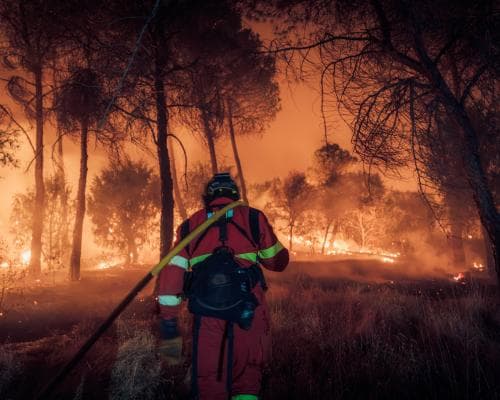
The first sign that something was wrong came not from a concierge or a private jet pilot, but from the air itself. Above the pine forests of Ávila, west of Madrid, the sky turned the color of bruised copper. By the time the authorities confirmed that Spain’s largest wildfire on record had consumed 50,000 hectares—123,000 acres of ancient oak and scrub—the fire had already rewritten the rules. In Gironde, southwestern France, a blaze described by regional prefect Sophie Brocas as “unlike any we have ever seen” was following its own logic, forcing firefighters to adapt in real time. The heatwave that followed was not a passing inconvenience. Spain’s meteorological agency, Aemet, warned it would be “long,” lasting at least until Sunday, with fire risk climbing to extreme levels. For those used to booking August in Bordeaux or September in Mallorca, the message was clear: the season of careless sun has ended.
For the luxury traveler, the calculus has shifted. The Gironde region is not just any patch of France—it is the beating heart of the wine world, home to Château Margaux, Château Lafite Rothschild, and the kind of private estates where the global elite gather for harvest tastings. When finance minister Roland Lescure spoke of a “shock to the regional economy,” he was not talking about lost tourist euros alone. He was talking about the 2023 vintage, the insurance claims, the smoke taint that can ruin a wine’s bouquet. The wealthy do not cancel their plans lightly, but they do recalibrate. The private-jet charter companies I spoke with report a surge in last-minute reroutes to Patagonia, New Zealand, and the Scottish Highlands. A client who once insisted on the last week of July in Saint-Tropez now asks for September in the Azores. The logic is simple: altitude and latitude matter more than the name on the hotel.
What makes this moment different is the scale. The wildfires near Madrid alone scorched 70,000 hectares—an area larger than the city of Paris. The blaze in Ávila became Spain’s largest on record, a grim milestone for a nation that has long managed fire with centuries of expertise. And the EU has warned that fires could still be burning into November, stretching what was once a four-week crisis into a half-year threat. For the ultra-wealthy, this is not a reason to stay home, but it is a reason to rethink the itinerary entirely. The new luxury is not a pool with an infinity edge; it is a destination where the air is safe to breathe. I hear of families who now demand real-time satellite data on fire risk before they book a villa. Private security consultants are being hired to monitor wind patterns. The concierge at one London-based travel management firm told me, “We now have a wildfire clause in every summer contract.”
This is the paradox of privilege: the more you can afford to escape, the more you realize there is nowhere to hide. The fires in France and Spain are not anomalies; they are the new baseline. The heatwave that Aemet warned would be “extraordinary” and “dangerous for vulnerable groups” is now a seasonal fixture. The elderly and those with cardiovascular conditions are advised to stay indoors. But what of the healthy, the mobile, the ones who can afford to go anywhere? They are learning that luxury travel is no longer about the most exclusive beach or the most remote château. It is about the most resilient destination. A place with a microclimate that buffers against the heat. A hotel with its own water reservoir and firebreak. A journey that begins not with a flight, but with a question: will the landscape I am paying to see still be there when I arrive?
So where do the wealthy go next? The answer is not a single destination, but a shift in mindset. The smart money is moving toward the shoulders of the season—late spring and early autumn—when the Mediterranean is still warm but the winds are less cruel. The Nordic countries are seeing a quiet boom: Iceland, Norway, the archipelagos of Finland, where the sun never sets and the air is cool. Closer to the fire zones, the high-altitude refuges of the Pyrenees and the Alps are gaining cachet, offering a kind of alpine escape that feels both luxurious and safe. One private club in the Swiss Alps has already sold out its entire summer for next year, not because of the skiing, but because of the certainty. The members want to know that the view from their terrace will not be obscured by smoke. They want to know that the vintage in their glass is not tainted by ash. And they are willing to pay a premium for that peace of mind.
For now, the fires still burn. In Ávila, in Gironde, across the parched hills of Spain and France, the firefighters are racing against a heatwave that shows no mercy. The luxury traveler watches from a distance, phone in hand, refreshing the satellite maps. The decision to cancel or reroute a summer holiday used to be a matter of whim. Now it is a matter of survival—not of the body, but of the dream. The dream of a golden afternoon in a French vineyard, of a quiet evening in a Spanish parador, of a world that still feels whole. That dream is not dead, but it has changed. It now requires a new kind of sophistication: the ability to read the wind, to understand the seasons, to know when to stay and when to go. And that, perhaps, is the most luxurious skill of all.
More in TRAVEL