The Point of No Return: Inside the Wimbledon Final Where Legs and Legacies Give Way
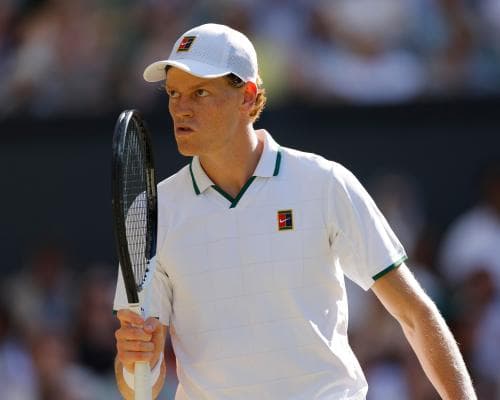
It began as a contest of equals. Two men, both built like Renaissance sculptures — Sinner all coiled spring and quiet ferocity, Zverev a tower of leverage and loping grace. They traded sets with the precision of Swiss watchmakers, each point a tiny masterpiece of torque and timing. But then, at 30-0 in the third, Zverev swiped a backhand wide and the story changed. He left the court not for a break, but for a reckoning. His knee, that capricious hinge of tendons and cartilage, had whispered something he could not ignore. The crowd felt it before the scoreboard did: a shift from athletic contest to something more elemental — a negotiation with fragility.
For the collector of rare experiences — the sort who flies private to Roland Garros for the clay, or charters a superyacht to watch the America’s Cup — this was the moment worth the price of admission. Not the winner, but the wobble. Zverev’s serve, which had been a guided missile all afternoon, dropped its contact point by three centimetres. The statistic, murmured by a commentator, hung in the air like a secret. Three centimetres: the distance between a champion’s hold and a mortal’s collapse. It is the kind of detail that separates a Wimbledon final from a practice session, and it is why the ultra-wealthy pay seven figures for Centre Court debentures. They come not just for the tennis, but for the exposed nerve.
Sinner, meanwhile, did what the great ones do when the moment demands it. He elevated. Not with a roar or a fist-pump, but with a quiet recalibration. When Zverev double-faulted at deuce, Sinner did not celebrate; he simply reset. He slipped himself in the next rally — skidding on the turf like a car losing traction on a wet road — but he got up, played two more shots, and watched Zverev float a backhand long. The Italian then hammered his racket into the grass, but it was a gesture of relief, not rage. He had served out the set to love, and the match, as a contest, felt suddenly over. The champion would serve for the set at 5-3, and the narrative had already been written.
What this match reveals about luxury taste is subtle but profound. The ultra-wealthy do not collect trophies; they collect moments of threshold. A first-growth Bordeaux is not about the wine, but about the decade it waited in a limestone cellar. A Patek Philippe is not about the time, but about the 2,000 hours of hand-finishing that went into its movement. Sinner’s victory — if it holds — will be remembered not for the final score, but for the three-centimetre drop in Zverev’s serve, the millimetre-long forehand, the slip that became a turning point. These are the details that connoisseurs of any discipline cherish: the tiny, almost invisible margin between triumph and tragedy.
As the sun slanted across Centre Court, casting long shadows on the grass, one could almost hear the whisper of future auction houses. A racket from this final, signed and authenticated, will one day hang in a Belgravia study or a Palm Beach billiards room. The chair umpire’s microphone, maybe, or a towel from the changeover. But the real commodity — the one that cannot be bought or sold — is the memory of that moment when Zverev’s knee refused to push off, and Sinner, without a word, stepped into the gap. That is the kind of story that gets told over dinner at Carbone, or on the deck of a motor yacht off Capri. It is the reason we watch, and the reason we collect.
And so, as the fifth set unfolded — if it unfolded at all — the lesson was clear. The game is not about who hits hardest. It is about who holds steady when the body starts to fray. In a world of hypercars and heritage villas, of bespoke everything and curated lives, the most valuable asset remains a quiet, unbreakable nerve. Sinner has it. Zverev, for one afternoon, did not. And that, in the end, is the only difference that matters.