The Art of the Chase: Shreyas Iyer’s Masterclass in Controlled Fury
The best things in life arrive unannounced. You do not schedule a perfect sunset, nor do you book a bottle of 1945 Château Mouton Rothschild. You simply find yourself in the right place at the right time, and the moment unfolds. So it was at the County Ground in Bristol, where the fourth T20 international between England and India turned into a private recital by one man: Shreyas Iyer.
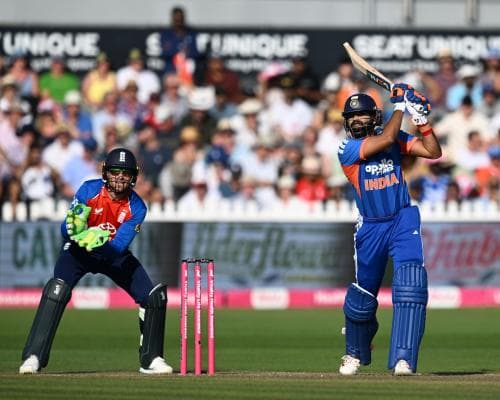
Iyer walked in with India wobbling at 121 for 4, the English attack smelling blood. Jofra Archer was steaming in, his bouncers humming with menace. Sam Curran was weaving his left-arm spells like a tailor measuring a suit—tight, precise, unyielding. And yet, Iyer did not flinch. He played as if he had all the time in the world, which is, of course, the ultimate luxury. He flicked a monstrous six off Josh Tongue with the lazy ease of a man swatting a fly on a veranda in Shimla. Then, in the 18th over, he slammed the accelerator: six, four, six—the last of those clearing long-on with such authority you could almost hear the scorch marks his dancing soles left on the turf.
Let us speak of craftsmanship, because that is what this was. Iyer’s innings was not a brute-force demolition; it was a study in controlled fury. He read the length early, trusted his hands, and chose his moments. When Archer dug in a short ball in the final over, Iyer did not try to muscle it. Instead, he hauls a bouncer over his shoulder, straight to the waiting Rashid at long leg—a dismissal that looked careless but was, in truth, the only risk he took all evening. His 80 came off 50 balls, a rate that whispers dominance rather than shouts it. For the collector of rare sporting moments, this was a Fabergé egg of an innings: delicate, precious, and utterly unrepeatable.
The context here is everything. England’s bowling attack is not a group of journeymen; it is a curated ensemble of pace, spin, and cunning. Archer, Tongue, Curran, Jacks, Rashid—each a specialist in their craft. That Iyer stood alone, with little support from the other end, made his performance all the more remarkable. He was a single diamond in a rough setting, and the crowd—those who understand the game’s finer textures—knew they were watching something special. The average first-innings score at Bristol is 158. India finished on 158 for 7, and Iyer had contributed exactly half of those runs. He was the difference between a score that looked pedestrian and one that felt, in the moment, like a declaration of intent.
For the luxury collector, there is a lesson here. The truly valuable is rarely the loudest. It is the quiet mastery, the ability to perform when the stakes are highest and the margin for error is a razor’s edge. Iyer’s innings was not a fireworks display; it was a perfectly tuned engine purring at redline without a single misfire. In the world of high-end timepieces, we call that a movement of exceptional quality. In cricket, we call it a knock that will be remembered long after the series is over.
What does this signal about taste? It suggests that the new connoisseur values substance over spectacle. They want the story behind the object, the provenance of the performance. Iyer’s innings had provenance: it was forged in the crucible of a hostile environment, against bowlers who are themselves at the top of their game. It was not a lucky day at the office; it was a masterclass in adaptation. And for those who follow the game with the same discerning eye they bring to a wine list or a car auction, that is worth more than any statistic.
Looking ahead, the question is whether Iyer can sustain this form. But that, perhaps, misses the point. The beauty of a moment like this is that it exists outside time. It is a snapshot of perfection, a single frame in a moving picture. Whether he scores another run or not, this evening in Bristol belongs to him. And for the rest of us, it is a reminder that the best luxury is not bought—it is witnessed.