The 46.760-Second Masterpiece: How Wales Forged a Commonwealth Games Record on Two Wheels
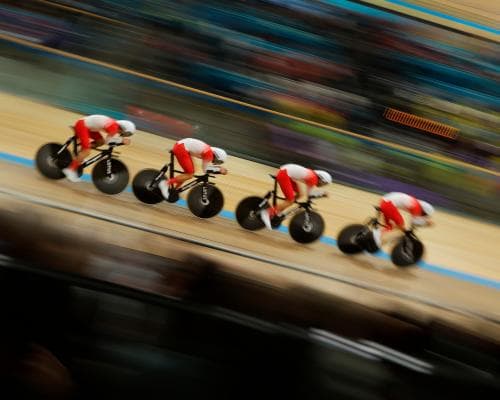
The velodrome hums with a tension that feels almost mechanical. The air is thick with the scent of rubber and sweat, and the crowd holds its breath. Then, a gunshot. Four women explode from the start line, their carbon-fibre machines hissing against the polished pine track. In 46.760 seconds, it is over. Wales has not only beaten England — they have smashed a Commonwealth Games record, carving their names into the history of track cycling with the precision of a master watchmaker.
This was no ordinary victory. It was a study in controlled fury, a ballet of biomechanics and aerodynamics. The Welsh quartet — a team of riders whose names will now echo through the halls of the Geraint Thomas Velodrome — delivered a performance that felt less like sport and more like a perfectly executed symphony. Their time, 46.760 seconds, is a number that tells a story of relentless training, marginal gains, and the kind of obsessive attention to detail that the ultra-wealthy recognise in a bespoke J.P. Morgan timepiece or a one-off Pagani. Every millisecond was earned, every pedal stroke a calculated risk.
The bikes themselves are marvels of modern engineering. Hand-built from aerospace-grade carbon fibre, each frame weighs less than a kilogram. The wheels are disc-shaped, designed to slice through air with the least possible resistance. The chainrings are machined from a single block of titanium. To the untrained eye, they look like futuristic sculptures; to the connoisseur, they are the result of thousands of hours of wind-tunnel testing and computational fluid dynamics. A single team pursuit bike can cost upwards of £30,000, and that is before the custom-fit handlebars, the bespoke saddle, and the skin-tight, low-drag racing suit that costs as much as a tailored Zegna jacket.
For collectors and connoisseurs of the rare and the refined, this race offers a different kind of currency. The Commonwealth Games record is not just a trophy; it is a marker of a moment when human and machine achieve perfect harmony. In the world of high-end horology, we speak of chronometers and tourbillons — mechanisms that defy gravity and friction. Here, on the track, the riders and their machines become a single, living chronometer, their performance measured to the thousandth of a second. The Welsh team’s time of 46.760 seconds is their own unique calibre, a record that may stand for years, much like a limited-edition Patek Philippe that never goes to auction.
What does this victory signal about luxury taste? It suggests that the discerning eye now looks beyond the static and the still. The true collector seeks the kinetic, the fleeting, the moment of peak performance. A vintage Ferrari GTO is magnificent in repose, but it is on the Mille Miglia that it earns its legend. Similarly, these Welsh riders and their machines are not just objects to be admired; they are instruments of a singular, breathtaking achievement. To own a piece of this — a signed race suit, a wheel from the record-breaking bike, a photograph of the finish line — is to own a fragment of time itself.
As the velodrome lights dim and the cheers fade, the record remains. It will be etched into the annals of the Commonwealth Games, a benchmark for future champions. But for those who were there, or who now study the timing sheets with the reverence of a collector examining a vintage chronograph, the 46.760-second masterpiece is more than a number. It is a reminder that the most exquisite luxuries are not things you can hold, but moments you can never forget. The Welsh team has given us that. And in the world of the ultra-wealthy, where experiences are the ultimate currency, that is priceless.