The Ceuta Avalanche: 50,000 Migrants in a Day — and the Wealth World's Newest Border Risk
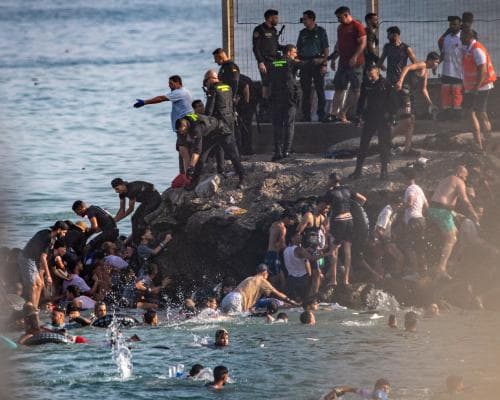
Fifty thousand people in 24 hours. That is not a festival crowd or a stock-market volume spike — it is the number of migrants who overwhelmed the Spanish enclave of Ceuta this week, and it is a number that should make every serious portfolio manager sit up. This was not a trickle or a slow-burn migration story. It was an avalanche, triggered by a single Spanish Supreme Court ruling that effectively told human traffickers: swim in, and you cannot be turned back at sea. Spain's prime minister, Pedro Sánchez, called it a violation of territorial integrity. For the wealth desk, it is something else: a live stress test of Europe's borders, its political cohesion, and the quiet assumptions behind billions in Mediterranean real estate and EU sovereign debt.
The scale is staggering. The Spanish government puts the crossing at about 50,000 people; the president of Ceuta says 60,000. Either way, that is roughly 70% of Ceuta's entire population of 85,000 arriving in a single day. At least 57 people died trying to make the crossing — a death toll that itself is a market signal. When borders fail with this ferocity, the ripple effects hit everything from local property prices to the political stability that underpins Spanish bonds. For context, Spain's GDP is around $1.4 trillion, and its 10-year bond yields have been trading at a premium to Germany's — a gap that could widen if this crisis morphs into a Schengen suspension, as some EU hardliners are demanding.
The mechanics of this particular wealth event are brutally simple. The Spanish Supreme Court recently ruled that migrants intercepted at sea cannot be summarily returned under special rules. That legal nuance, as Sánchez put it, 'spread like wildfire through the networks of mafias that traffic in human beings.' The traffickers did not need to smuggle people in boats — they just told them to swim, wade, or paddle to Ceuta's Tarajal beach, where Spanish authorities could not legally push them back. The result was a human wave that overwhelmed the city's infrastructure, forced Madrid to set up a temporary reception centre, and prompted Sánchez to order a visible barrier — a line of buoys — to mark the border and comply with the court's ruling. The buoys are a stopgap. The underlying issue — a legal vacuum that traffickers exploit faster than any bureaucracy can respond — is the real story.
For the wealthy, the immediate capital angle is in how this crisis reshapes risk. Ceuta and Melilla, Spain's two North African enclaves, are not just geopolitical curiosities; they are gateways for migration flows that have historically been a key driver of EU border-control spending — a market worth billions in surveillance tech, fencing, and patrol assets. But the bigger play is in sovereign risk. If Spain gets suspended from Schengen, as some EU members have suggested, the economic cost could be severe — free movement is worth an estimated 2-3% of GDP for member states. That is a direct hit to Spanish growth, tax revenues, and bond valuations. The wealthy who hold Spanish real estate, particularly in coastal regions, should watch this closely: border instability tends to depress property values in affected areas, even if the enclaves themselves are tiny.
But there is a deeper, more structural signal here for global capital. The Ceuta event is a reminder that 'safe haven' Europe is not immune to the volatility of human desperation. Migration flows are a function of poverty, climate stress, and conflict — and they are accelerating. The UN estimates that 281 million people live outside their country of origin, and that number is growing. For wealth managers, this means that border crises are no longer a tail risk; they are a recurring feature of the investment landscape. The question is not whether another Ceuta happens, but where — and how fast capital can reposition. The wealthy are increasingly using alternative assets — from farmland in stable jurisdictions to infrastructure that benefits from border security spending — as a hedge. This crisis will only accelerate that trend.
Looking forward, the immediate focus is on how Sánchez manages the next 48 hours. He has promised 'expedited' expulsion for those with no legal claim, but the court ruling limits his options. The buoys may deter some, but traffickers will adapt. The real test is whether the EU can agree on a unified border policy that is both humane and enforceable — a political challenge that has stumped Brussels for years. For investors, the takeaway is clear: the risk premium on Southern European assets just went up. Not because of a debt crisis or a banking failure, but because a single court ruling turned a border into a floodgate. That is the kind of event that does not show up in a Monte Carlo simulation — until it is already on your beach. And when it does, the only real hedge is diversification, agility, and a clear-eyed view of how quickly human flows can upend the most orderly of markets.