The Radical Elegance of ‘Access Is Love’
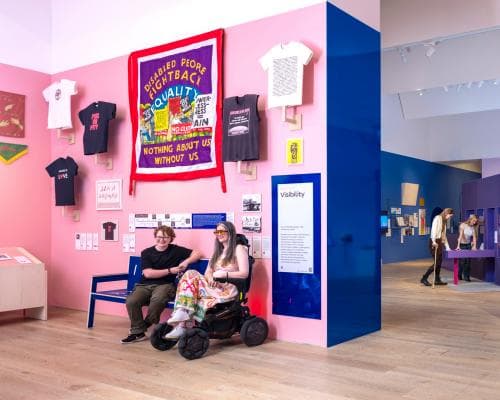
The first T-shirt hits you like a perfectly tailored suit: crisp, white, and bearing the words “Access is love.” You almost smile. Then you see the next one: “Piss on pity.” It’s a gut punch, and it’s meant to be. This is the opening salvo of the V&A Dundee’s new exhibition, *Design and Disability*, and it announces itself with the kind of unapologetic clarity that the ultra-wealthy usually reserve for a bespoke Hermès Birkin or a one-of-a-kind Pagani. But here, the luxury is something far rarer: the right to exist in public without apology.
The exhibition draws its emotional spine from the 1990 Block Telethon protests, when hundreds of disabled activists gathered outside ITV studios in London to disrupt a charity telethon. They weren’t asking for pity. They were demanding dignity. That moment—raw, loud, and brilliantly choreographed—is the spiritual ancestor of the show. And it’s a masterclass in what the wellness world might call radical self-care. Because true wellness isn’t just about a $10,000 cryotherapy chamber or a week at a Swiss clinic. It’s about the systemic conditions that allow a person to move through the world without being treated as an afterthought.
The objects on display are not the usual luxury fare. There are no hand-stitched leather journals or limited-edition watches. Instead, you find a wheelchair designed by a collective of disabled makers, its frame welded with the precision of a fine bicycle. A pair of gloves that translate sign language into text. A set of ramps that fold like origami, small enough to slip into a Prada tote. Each piece is a testament to the idea that good design is not a privilege—it is a right. And the best design, like the best hospitality, anticipates need before it is spoken.
What makes this exhibition so quietly radical is its refusal to treat accessibility as a chore. It presents it instead as a form of connoisseurship. The curators have arranged the space so that every object is at the perfect height for a person in a wheelchair, and every label is printed in both Braille and large type. There are no awkward corners, no steps, no whispered apologies. It feels less like a museum and more like a perfectly run private club—one where the membership criteria is simply being human.
For the collectors and tastemakers who read this desk, the lesson is subtle but profound. The most covetable thing you can own right now is not a limited-edition Richard Mille or a vineyard in Provence. It is the ability to see the world through someone else’s frame. The exhibition includes a series of photographs of disabled activists in their homes, each image composed with the care of a Vogue editorial. These are not portraits of suffering. They are portraits of agency, of resourcefulness, of a kind of grace that money alone cannot buy.
In the final gallery, a single T-shirt hangs alone on a white wall. It reads: “Crip the future.” It is both a warning and an invitation. The future of luxury, like the future of wellness, is not about accumulation. It is about access. It is about designing a world where the door is wide enough for everyone—and where, when you walk through it, you are met not with pity, but with love.