The Three-Year-Old Who Stole the World Cup: Keyne Yamal’s Reign from the Stands

The most sought-after ticket in the 2026 World Cup isn’t for a VIP box or a pitch-side seat. It’s for a glimpse of a three-year-old boy in the stands, blowing kisses and sticking out his tongue. While the world’s finest athletes chase glory on the grass below, the cameras have found a new fixation: Keyne Yamal, the toddler brother of Spanish winger Lamine Yamal, whose every expression is now a global event. In an age of curated celebrity and polished brand narratives, this tiny, unscripted personality has become the ultimate luxury—a reminder that the most captivating performances aren’t rehearsed.
Keyne’s coronation as Spain’s “superstar fan” reached its peak after Spain’s quarterfinal victory over Belgium. As the team celebrated, the stadium’s giant screens caught Keyne making a series of funny faces. On the pitch, Lamine spotted his brother and laughed—a moment of genuine, unguarded connection that ricocheted across social media within seconds. Hola! magazine declared him “the biggest sensation of the competition,” surpassing athletes, goals, and even the trophy itself. SPORTbible put it more bluntly: “It’s Keyne’s world, and we’re all just living in it.” For the ultra-wealthy, who often pay millions for exclusive access and curated experiences, Keyne offers something rarer: the thrill of the unrepeatable, the charm of the authentic.
What makes this phenomenon so compelling is its absolute lack of artifice. Keyne is not a brand ambassador or a child influencer groomed for the spotlight. He is simply a toddler who called his brother before the match—using their mother’s phone—to announce his plan to stick out his tongue. “So that’s why when I saw him on the screen, it really made me laugh,” Lamine told journalists afterward. In a world where every moment is staged for maximum impact, Keyne’s spontaneity is a quiet rebellion. It echoes the ethos of the finest craftsmanship: the belief that true beauty lies in imperfection, in the unpolished edge that no algorithm can replicate.
The market for such authenticity is, paradoxically, insatiable. Collectors of rare experience—whether a first-edition Patek Philippe or a private viewing of a Basquiat—know that the ultimate status symbol isn’t a thing, but a feeling. Keyne’s antics offer that in spades. They are the equivalent of a perfect, unplanned sunset on a private yacht: impossible to buy, impossible to replicate. For the readers of The Curated Life, this is the new frontier of luxury. Not the hypercar or the penthouse, but the moment when a three-year-old’s joy becomes the most valuable currency in the room.
What does Keyne’s reign signal about the evolution of taste? It suggests that the ultra-wealthy are increasingly drawn to the unscripted and the intimate. The curated life, it turns out, has a limit. After a certain point, the most exclusive acquisition is a piece of genuine human connection—the kind that cannot be ordered from a catalog or reserved in a private club. Keyne’s World Cup takeover is a masterclass in this shift: a reminder that the most powerful luxury is the ability to laugh, unguarded, in front of billions.
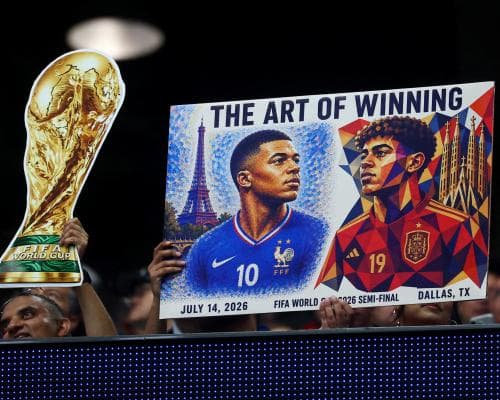
As Spain advances to the semi-finals, the question on every collector’s mind is not who will lift the trophy, but what Keyne will do next. Will he blow a kiss? Flash a peace sign? Or simply stare into the camera with the unreadable stillness of a toddler who knows he holds all the cards. Whatever it is, it will be priceless. And for a brief, glorious moment, the world will stop to watch—not for the goals, but for the pure, unscripted magic of a three-year-old who reminds us that the best things in life are never for sale.