The Last Horizon: The Lovell Telescope and the Price of Wonder
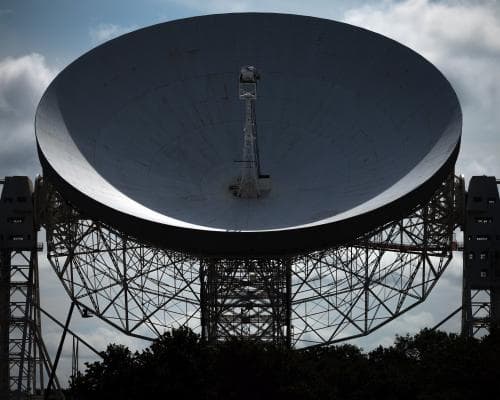
There is a particular kind of silence that falls over the Cheshire countryside at dusk, when the sky turns the colour of old pewter and the Lovell Telescope rises from the flatlands like a monument to human longing. It is not a yacht, nor a penthouse, nor a vintage chronometer. But for those who understand the quiet thrill of owning a piece of the impossible, this 76-metre dish is the ultimate collectible: a machine that has spent nearly seven decades listening to the universe's whispered secrets.
Jodrell Bank has always been the place where the very rich and the very curious meet—not in person, but in spirit. When the Lovell telescope tracked Sputnik in 1957, it wasn't just a scientific triumph; it was a moment of pure, unadulterated awe, the kind that money cannot buy but that the ultra-wealthy spend entire lifetimes chasing. Today, the telescope contributes to dark matter research, peering into the void with a patience that would make a seasoned art dealer weep. And now, this icon of British ingenuity is threatened with closure, its fate sealed by a budget line item: £2.8 million a year, a sum that would barely cover the annual mooring fees for a modest superyacht in Monaco.
The Science and Technology Facilities Council (STFC), which disperses government funding across particle, astro, and nuclear physics, has announced that funding will cease after March 2028. The projected savings are a rounding error in the national budget, yet the message is clear: the era of grand, fundamental discovery is being traded for the era of measurable, economic output. It is a shift that should unsettle anyone who has ever stood beneath a clear night sky and felt the vertigo of infinity. For the collectors among us, it raises a pointed question: what is the value of a thing that cannot be owned, only experienced?
The craftsmanship of the Lovell telescope is a masterclass in mid-century ambition. Designed by Sir Bernard Lovell and built in 1957, it was the largest steerable dish in the world at the time, a feat of engineering that required the precision of a Swiss watchmaker and the audacity of a rocket scientist. Its surface is a lattice of steel and wire, tuned to catch the faintest radio whispers from galaxies billions of light-years away. To walk beneath it is to feel the weight of history—and the lightness of being. It is not merely an instrument; it is a landmark, a piece of Britain's post-war optimism made physical, like a Concorde or a Mini Cooper, but with far grander ambitions.
In the world of high-end collecting, provenance is everything. The Lovell telescope has it in spades: Sputnik, the Apollo missions, the discovery of quasars, and now dark matter. Yet unlike a classic car or a first-edition folio, its value cannot be appraised at auction. It is a public good, a shared treasure, and that is precisely why its closure feels like a betrayal. The STFC's decision is part of a broader £160m savings package, which includes cuts to international collaborations with CERN and other telescope arrays. The UKRI, the parent body, has revamped its funding model to prioritise economic growth and measurable outcomes—a philosophy that would have killed the Renaissance, the Enlightenment, and arguably the iPhone, had it been applied with such ruthless pragmatism.
For the ultra-wealthy, who increasingly collect experiences over objects, the Lovell telescope represents the rarest commodity of all: perspective. A private jet can take you to the edge of the earth, but only a machine like this can take you to the edge of time. The fact that it costs less than a single day of a hedge fund manager's trading losses to keep it running is a scandal dressed in spreadsheets. And yet, there is a glimmer of hope. The outcry over the cuts has been loud, and the House of Lords has already questioned the STFC's logic. Perhaps the telescope will be saved by a last-minute intervention, or perhaps it will become a relic, a monument to a time when Britain believed in the future enough to build it.
What does this signal about luxury taste in 2025? That the truly discerning are no longer satisfied with owning the best of what exists; they want to own the best of what could be. The Lovell telescope is not a yacht, but it is a vessel—one that sails through the cosmos with a grace no superyacht can match. As the funding clock ticks down, the question is not whether we can afford to keep it, but whether we can afford to let it go. For a generation that has grown accustomed to buying wonder, this is the one purchase that cannot be made. And that, perhaps, is the most luxurious thing of all.