The Sunbrella Ascends: Fashion’s Most Refined Heatwave Companion
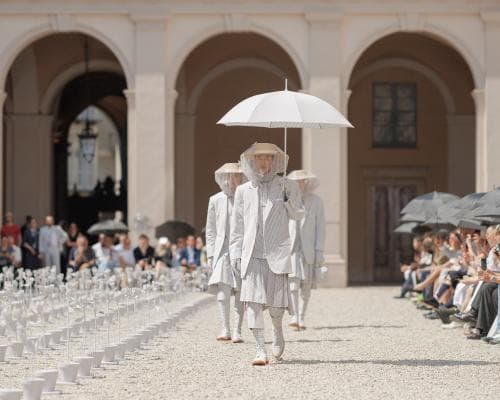
In a season defined by record-breaking heat, the discerning have found their cool in an unlikely silhouette. The umbrella, long relegated to the realm of drizzly commutes and forgotten taxi cabs, has been reborn as the definitive luxury accessory of the summer. When Lewis Hamilton stepped into the paddock at the Austrian Grand Prix, his Ferrari-red umbrella was not merely a shield against the sun—it was a declaration. The race suit matched the canopy, the brand allegiance was unmistakable, and the message was clear: personal climate control has become the ultimate signifier of refined taste.
This is not the utilitarian brolly of yesteryear. At the Dior show during Paris Fashion Week, guests including James Marsden and Mike Faist were handed large cream umbrellas as temperatures hit 38°C—a gesture that transformed a practical necessity into a curated moment of shared elegance. Earlier that week, on the alfresco runway of Thom Browne in Milan, models carried grey-and-white-striped golf-style umbrellas, while the front row wielded sleek black versions as if they were scepters. The sunbrella, as it is now being called, has crossed the threshold from weatherproof tool to seasonal couture.
Craftsmanship, as always, separates the merely functional from the truly covetable. Houses such as Burberry and Hermès have long championed three-figure brollies engineered for downpours, but their summer siblings demand equal pedigree. The finest examples are handcrafted from lacquered hardwood shafts, with canopies cut from UV-resistant silk-cotton blends that fold into a silhouette as precise as a tailored jacket. At James Smith & Sons, the venerable London umbrella atelier, store manager Phil Naisbitt notes a surge in orders for lightweight, sun-ready designs. “Customers are asking for handles in exotic woods and custom monograms,” he says, “and they want the fabric to complement their summer wardrobe, not just their raincoat.”
The market has responded with quiet alacrity. Morgan Cros, founder of the London brolly brand Original Duckhead—known for its signature duck-shaped handles—reports that summer sales now rival those of the traditional rainy season. “Umbrellas have become much more of a year-round product,” Cros explains. “The sun drives steadier demand than the rain ever did.” This shift is not merely meteorological; it reflects a deeper evolution in how the wealthy approach comfort. Brian Diffey, the dermatological scientist who invented the UVA star rating for sunscreen, puts it succinctly: “An umbrella provides your own personal shade. The main benefit is that it acts as a heat reducer.” In a world where every degree of thermal luxury is engineered—from chilled towels at Wimbledon to misting systems on private terraces—the sunbrella is the most portable, most visible, and most elegant solution yet.
For the collector, the sunbrella signals a new frontier of taste. It is an accessory that requires no power, no subscription, no carbon footprint, only the quiet confidence to carry a statement of personal microclimate. It nods to the parasols of Belle Époque society while remaining rigorously modern—Hamilton’s Ferrari red, the Dior cream, the Thom Browne stripes are all markers of a moment when utility and high fashion have finally, beautifully converged. To own a bespoke sunbrella is to understand that luxury is not about excess but about mastery over one’s environment, even when that environment is a heatwave.
As the mercury continues to climb, the sunbrella will only gain currency. Expect to see it at the next Grand Prix, the next yacht launch, the next private view in St. Moritz or the Hamptons. It is the quietest of flexes, the most refined of shelters, and the surest sign that the truly sophisticated have found their shade—and are not about to share it.


