The Last Uncommodified Wilderness: Uruguay’s Football Fury and Cape Verde’s Soulful Stand
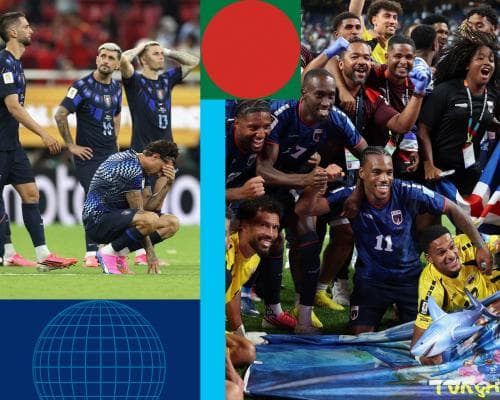
The Geopolitics World Cup has its North Korea 1966, its Cameroon 1990 — rank outsiders that revive hearts hardened by relentless cynicism. For Pak Doo-ik and Roger Milla, read Vozinha, and all his Cape Verde teammates, including Pico Lopes, a defender recruited while playing for Shamrock Rovers from the diaspora via LinkedChat. An archipelago nation with a population smaller than Bradford has negotiated a tough group including two former winners in Spain and Uruguay. They will next meet Argentina in Miami, the adopted city of Lionel Messi, where the fairytale likely ends. Though if not, then they would become the greatest World Cup story of all. “We are small but we have big hearts,” sobbed Vozinha following a 0-0 draw with Saudi Arabia and a quick check on the other Group H result from Guadalajara. This is not a tale of five-star lodges or champagne safaris; it is a pilgrimage to the last uncommodified wilderness: the human spirit in its most raw, unvarnished form.
Talking of football heritage, Uruguay exiting in a flurry of filth and fury during their 1-0 loss to Spain showed off something else not yet commodified and flogged to the highest bidder. Marcelo Bielsa’s tournament legacy is mixed. His Argentina team of all the talents were dumped out at the group stage in 2002 amid floods of woe. Chile in 2010 played some of the loveliest soccer on show in South Africa before exiting to Brazil in the last 16. A third stab with Uruguay has been a self-confessed disaster. Such true confessions were made most publicly. Bielsa’s guttural demand that the flash interviewer hurry the bleep up was followed by a paint-stripping mea culpa. “I haven’t left anything to Uruguayan football,” he sniffed, hurling himself through the door marked DO ONE. The warnings had been there pre-tournament, Bielsa declaring he had been “toxic” with his players. Following drab draws with Saudi Arabia and Cape Verde, against a Spain team grinding out a 1-0 victory, Uruguay’s exit was a masterclass in unscripted, unsponsored emotion — the kind that cannot be booked or bought.
For the discerning traveller who has sipped Krug in the Okavango Delta and watched the sun set over the Skeleton Coast, the true frontier is no longer geographical but emotional. Cape Verde’s journey — a nation of volcanic islands and creole soul, where the music of morna drifts through cobblestone streets in Mindelo — offers an immersion into a culture that has not been polished for Instagram. The diaspora connection, with players like Pico Lopes recruited via the digital backchannel of LinkedChat, speaks to a modern, networked intimacy that no concierge can replicate. This is access to the authentic: the tear in Vozinha’s eye, the roar of a stadium in Praia, the weight of a nation on eleven shoulders. It is a safari of the heart, and its price is not measured in dollars but in surrender.
The rarity angle is stark: Uruguay’s fury and Cape Verde’s fairytale are vanishing assets in a world where every emotion is algorithmically optimized. Bielsa’s confession — “I haven’t left anything to Uruguayan football” — is the kind of raw, unguarded moment that luxury travellers pay fortunes to witness in remote corners of the globe, yet here it was broadcast free of charge. The heritage of Uruguay’s sky-blue shirts, the legacy of 1930 and 1950, collided with the modern reality of a manager who refused to commodify his soul. For the ultra-wealthy, this is the ultimate signal: the most exclusive experience is no longer a private island or a bespoke itinerary, but a front-row seat to unscripted humanity. Where the wealthy go next is not to a new continent, but to the edges of authenticity — to Cape Verde’s salt flats and Uruguay’s ramshackle stadiums, where the only currency is passion and the only itinerary is the one written by fate.


