The Gilded Revolt: Inside Volkswagen’s Battle for Survival and Status
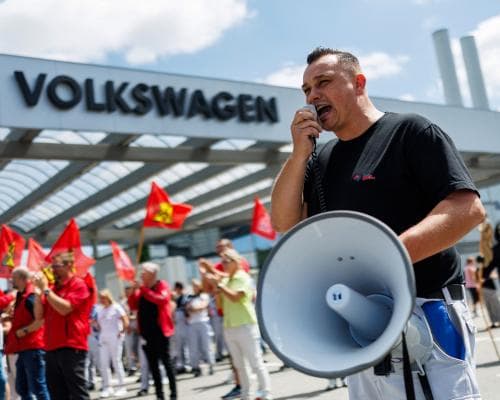
The whistle cuts through the cold German air. Not a celebration, but a warning. At the Osnabrück plant, 70 workers stand at the gate, banners raised, blowing hard against a proposal that could shutter four factories and slash up to 100,000 jobs. This is not a scene from Detroit’s decline. This is Wolfsburg, the cathedral of automotive power, where the very idea of German engineering began. For the ultra-wealthy, the tremor is seismic. The car that signals arrival—the Audi, the Porsche, the Bentley—is built on a foundation now cracking. If Volkswagen stumbles, the entire ecosystem of luxury mobility trembles.
Here is the raw truth: Volkswagen’s supervisory board met Thursday to review a radical transformation plan from CEO Oliver Blume. The numbers are staggering—up to 100,000 job cuts, four German plants possibly closed (Hanover, Emden, Zwickau, and Audi’s Neckarsulm), and a potential spin-off of the core brand division. The union IG Metall organized protests at 18 sites, with leaders like Stephan Soldanski demanding straight answers. The message from the workforce was blunt: do not pass the buck for failures onto us. But for the collector eyeing a bespoke Bentley Mulliner or a limited-run Porsche 911, this is not just labor strife. It is a reckoning for a 650,000-employee empire that underpins the German economy—and the taste of the global one percent.
Craftsmanship is the soul of Volkswagen’s luxury brands. The hand-stitched leather in a Bentley, the precision of a Porsche flat-six, the silent torque of an Audi e-tron—these are not mass-produced widgets. They are the result of decades of heritage, trained hands, and plants that hum with ritual. Yet the company is now weighing the sale of unviable factories to foreign competitors. Imagine: the same factory that once shaped a legend could become a badge on a different grille. The union calls the workers “gutsy.” I call them guardians of a craft that cannot be replicated in a spreadsheet. The proposed carve-out of the core brand and components technology division threatens to sever the very thread that ties a Skoda to a Bentley—a shared DNA of over-engineered excellence.
What does this signal about wealth and taste? In the luxury market, provenance is currency. A Porsche 911 Turbo S is not just fast; it is a story of Zuffenhausen. An Audi R8 is a sculpture from Neckarsulm. If those plants close, the narrative fractures. The ultra-wealthy do not buy cars; they buy continuity. They buy the idea that their investment will be serviced, cherished, and understood by the same hands that built it. Volkswagen’s crisis is a mirror for the entire sector: as the industry pivots to electric, software-defined vehicles, the old temples of metal and grease may become museums. The VDA, Germany’s auto trade body, warns of “potential employment collapse” unless bold decisions are taken. For the billionaire, bold decisions mean preserving rarity. A factory closure does not just kill jobs—it kills the supply of future collectibles.
Looking forward, the board’s decision will set a precedent. If Blume succeeds in simplifying the sprawling structure, the surviving plants could become even more exclusive—smaller, more bespoke, more expensive. Think of it as the Hermès strategy applied to steel and rubber. But if the cuts are too deep, the trust that underpins a €200,000 purchase evaporates. The protest at Osnabrück is not just a labor action; it is a cry for the soul of an industry that defines German prestige. For the discerning buyer, now is the time to watch closely. The next chapter of automotive luxury is being written not in a design studio, but on a factory floor, with whistles and banners. The question is: will the story end in a museum or a masterpiece?
For those who can afford to wait, the smart move is to secure a build slot now. As factories shrink, so does availability. The whistle you hear might be the last call for a piece of history.
The Experience
Secure a private consultation with our automotive heritage concierge to explore limited-production models from Porsche, Audi, and Bentley before allocations vanish.
More in BUSINESS

The Verdict That Redefines Automotive Trust: What Dieselgate’s Final Act Means for the World’s Most Discerning Collectors

The £11 Billion Soundtrack: How Oasis and the Ultra-Rich Turned Live Music into the Ultimate Status Signal
From Frump to Front Row: Marks & Spencer’s Century-Old Coup at London Fashion Week