The Queen’s Gambit, Live: Inside ChessFest’s Triumphant Return to Trafalgar Square
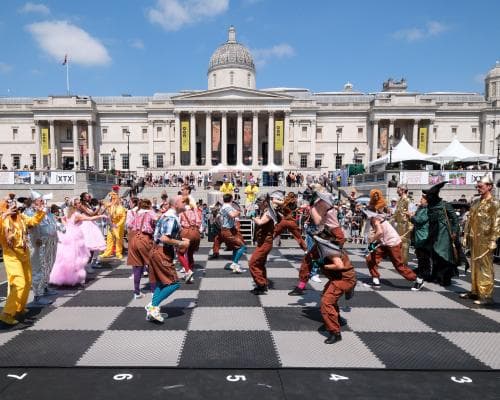
The first thing you notice is the silence. Not the silence of a library, but the charged hush of a hundred minds working in unison. On a Sunday afternoon in July, Trafalgar Square—normally a cacophony of tourists, pigeons, and street performers—becomes something else entirely: a vast, open-air chess salon. ChessFest returns to London on July 12, and for those who collect experiences as carefully as they collect vintage cars or art, this is the season’s most unexpected invitation.
This is not your grandfather’s chess club. The annual celebration, now in its fifth year, brings together nine-time British champion Michael Adams, three-time champion Gawain Maroroa Jones, and a constellation of international grandmasters. They sit at tables in the shadow of Nelson’s Column, playing simultaneous displays against anyone bold enough to sit opposite them. The price of admission? Zero. The value of a single move from a grandmaster? Priceless. For the ultra-wealthy parent seeking to cultivate a child’s strategic mind—or simply to witness the quiet thrill of genius at work—this is a masterclass in patronage without the velvet rope.
The craftsmanship here is not in metal or wood, but in the architecture of thought. Grandmasters like Adams and Jones play multiple games at once, their eyes flickering across boards like a conductor reading a score. In the Challenge the Chess Master tent, visitors can pay for one-on-one speed games—a rare chance to feel the heat of a champion’s concentration. Giant chess sets dot the square, where professional actors perform Living Chess, turning the board into a theater of human pieces. For the collector of rare experiences, this is the equivalent of watching a Stradivarius being played: the instrument is the mind, and the music is the game.
Market context is everything in the world of luxury, and chess has quietly become a status signal among the cognoscenti. The 2020 Netflix series *The Queen’s Gambit* ignited a renaissance that shows no sign of cooling. High-end clubs in London, New York, and Dubai now offer membership tiers for serious players. Chess sets from artisans like Jaques of London or House of Staunton command five figures. Yet ChessFest remains defiantly democratic—a deliberate choice by its sponsor, XTX Markets, which also underwrites the annual London Classic. The message is clear: true luxury is access, not exclusivity. To watch a six-year-old prodigy like Kushal Jakhria—who first faced Adams at ChessFest in 2021 and later won world and European junior titles—is to witness the future of the game being forged in real time.
What does this say about luxury taste today? It says that the most discerning collectors are turning inward, investing in the muscle of the mind. A Bugatti or a Breguet is a statement; a child who can hold her own against a grandmaster is a legacy. ChessFest offers a rare intersection of public spectacle and private ambition. England’s national coaches will be scanning the crowds for undiscovered talent, their eyes searching for the next prodigy amid the chaos of a summer afternoon. For the parent who values intellectual capital over material wealth, this is the ultimate scouting ground.
As the sun sets over Trafalgar Square and the last pieces are packed away, the square returns to its usual hum. But for those who played, who watched, who felt the weight of a grandmaster’s gaze, the memory lingers. ChessFest will roll on to Portishead, Hull, and Liverpool in the following weeks, but the London edition remains the crown jewel—a day when the city’s most public space becomes a private conversation between minds. For the ultra-wealthy, it is a reminder that the most exclusive club in the world is the one you enter with nothing but your wits.