When the Peloton Breaks: The Human Drama Behind Tour de France Stage 15
The Tour de France is a machine of precision, but machines break. At 2:00 AM on stage 15, Jonas Vingegaard was roused from his hotel bed by the International Testing Agency. He submitted to a doping control, then climbed back into the dark. Hours later, on the approach to the Plateau de Solaison, his right arm in a sling, he was helped into an ambulance. The double champion was out. The peloton had lost its quiet king. And the race, already a spectacle, became something else entirely: a masterclass in how quickly fortune flips in the world’s most punishing sport.
This is not a story about carbon fiber or gear ratios. It is about the human cost of chasing yellow. Vingegaard, who won the Giro d’Italia earlier this year, had been the race’s stoic anchor—a rider whose calm belied a ferocious climbing engine. His exit, triggered by a roundabout in Bonneville, was a reminder that no amount of aerodynamic wizardry or data-driven training can bulletproof a body against the randomness of a two-wheeled ballet at 50 kilometers per hour. The crash was not spectacular; it was mundane. A touch of wheels, a slip of focus, and the race changed forever.
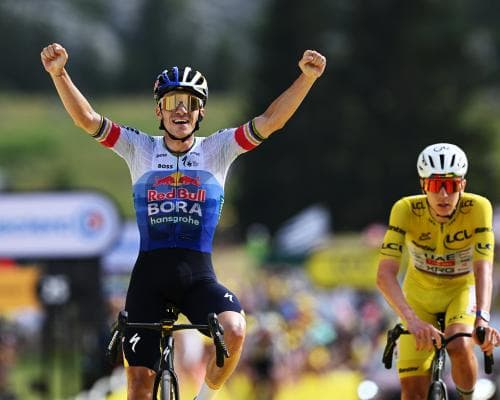
For those who collect not just cars but stories of endurance, this stage was a rare artifact. Tadej Pogacar, the race leader and Vingegaard’s great rival, spoke afterward with a candor that cut through the usual press-conference polish. “We are competitors and also kind of friends,” he said. “The tour will not be the same without him.” He wondered aloud if the early-morning testing had cost Vingegaard his edge. It was a generous thought, and a rare one in a sport where every watt is hoarded. Meanwhile, Remco Evenepoel—the Belgian prodigy who rides for Red Bull-Bora-Hansgrohe—seized the moment. He attacked on the final climb and won the stage, finishing five minutes ahead of Pogacar. His team principal called him “a rocket.” Evenepoel himself, ever the provocateur, promised to be “a pain in the arse next week.”
The drama raises questions the luxury world rarely asks: What is the price of peak performance? Vingegaard’s 2:00 AM test was legal, but it punctured the ritual of rest that elite athletes guard like a sacred hour. The Tour’s organizers, the ASO, have long insisted on rigorous controls, but this felt like a breach of the unspoken code—a reminder that even the most polished machines are subject to inspection. For collectors who admire the precision of a derailleur or the engineering of a time-trial bike, the lesson is clear: the human element remains the most fragile component.
In the market of cycling fandom, Vingegaard’s absence reshapes the narrative. Pogacar, now the overwhelming favorite, becomes a different kind of champion—one who must win without his foil. Evenepoel, young and volatile, becomes the wildcard. Their bikes, their helmets, their nutrition—every detail will be scrutinized by a global audience that treats the Tour as a living museum of human potential. The crash, the doping test, the victory: these are not just sports headlines. They are the raw material of a modern epic.
What does this signal about luxury taste? That the most coveted experiences are not always the most comfortable. The ultra-wealthy who charter helicopters to follow the race, who commission custom-painted Colnagos, who debate the merits of disc brakes versus rim brakes from their chalets in Megève—they are not buying a result. They are buying a front-row seat to chaos and grace. Stage 15 delivered both. As the rest day dawns and the Alps loom, the Tour reminds us that perfection is a myth. The real prize is the story. And this year, it is written in blood, ambition, and the quiet hum of a peloton that rolls on without its king.