The Final Port of Call: Washington Bids Farewell to a Lion
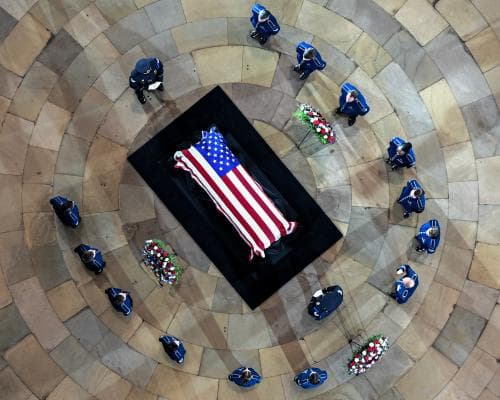
On a crisp Washington morning, Wisconsin Avenue sat empty as a marble corridor. The usual hum of diplomatic sedans and black Suburbans had been replaced by a silence so thick it felt poured from lead. Two dozen Metropolitan Police cruisers lined the curbs like polished tombstones. Secret Service agents, earpieces glowing, scanned every window, every rooftop. This was not a funeral. This was a state-level security architecture designed for a head of state—or, in this case, for a senator whose final guest list included the man who once sat in the Oval Office and the man who currently does.
Inside the Washington National Cathedral, the limestone vaults echoed with the low hum of an organ prelude. The pews were filled with the kind of faces you see on the covers of *Fortune* and *The Atlantic*—not because they seek attention, but because they command it. Donald Trump, JD Vance, Defense Secretary Pete Hegseth, Treasury Secretary Scott Bessent, Interior Secretary Doug Burgum, and White House chief of staff Susie Wiles all took their places. The motorcade from the White House had sliced through the lockdown like a blade. For the collector of power—the person who buys a $28 million penthouse not for the view but for the address—this was the ultimate provenance: a funeral where the eulogist is a former president and the security footprint rivals a G20 summit.
But what made this gathering truly rare was not who sat inside, but who stood outside. At the edge of the security fence, a handful of locals waved an American flag, a Ukrainian flag, and a NATO flag. One woman, wearing a T-shirt that read “childless cat ladies against fascism,” told our reporter she had never seen security so intense. “This is insane. We’ve never seen it like this,” she said. Nearby, a dozen silent protesters held Palestinian flags. One, a woman named Sumer, called Graham a war criminal for his support of Israel’s operations. “He’s not someone who deserves an honorary funeral,” she said. The juxtaposition was perfect: inside, the machinery of state; outside, the raw, unfiltered voice of a divided republic.
For the ultra-wealthy, the value of an event like this is not measured in dollars but in access. The guest list alone—Trump, Vance, the entire national security apparatus—reads like a private equity portfolio of American power. To be in that room is to own a piece of the narrative. The security lockdown, the bomb-sniffing dogs checking every bus, the airspace closed over the cathedral—these are not inconveniences. They are the velvet rope of history. The woman in the protest T-shirt was right: we have never seen it like this. And that, for the collector, is precisely the point.
What does this tell us about luxury taste in 2025? That the ultimate status symbol is no longer a 200-foot motor yacht or a case of Petrus. It is proximity to the tectonic plates of power—the ability to say, “I was there when the cathedral went dark and the city stopped breathing.” The ultra-wealthy have always collected experiences. But the most coveted experiences now are those that cannot be bought. They are inherited by invitation, by relationship, by the quiet currency of being in the right room at the right moment of history.
As the service concluded and the motorcades rolled away, the empty street began to fill with the ordinary rhythm of taxis and delivery trucks. The cathedral doors closed. The flags were folded. But for those who were inside—and for those who watched from the fence—the memory of that morning will remain as polished and rare as a vintage Patek Philippe. In a world of endless content, the truly valuable thing is the moment that cannot be livestreamed.