Australia's Migration Reset: Labor's Quiet Plan to Shrink the Labor Pool
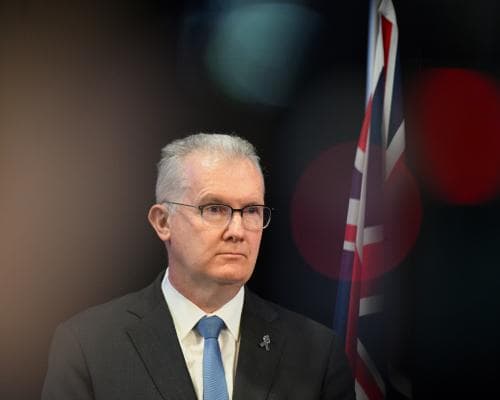
There is a moment in every economic cycle when the invisible hand becomes a very visible fist. For Australia, that moment is now. Home affairs minister Tony Burke was scheduled to address the National Press Club tomorrow, ready to talk about "managing the migration program." The address was pulled at the last minute, reportedly due to internal political sensitivities. But the direction of travel is unmistakable: Labor is preparing to slam the brakes on the country's biggest demographic driver of growth.
The numbers tell the story. Net overseas migration has already fallen to its lowest level since 2022, and the government wants to push it lower still. This is not just a political move designed to blunt One Nation and Coalition attacks. It is a structural shift in how Australia plans to grow its economy. For two decades, the playbook was simple: import workers, build houses, watch GDP climb. That playbook is being rewritten in real time, and the market has not fully priced it in.
The mechanics of this shift are worth understanding. The government is not just tweaking visa caps; it is changing the composition of who stays and who leaves. Temporary residents — the backpackers, the skilled visa holders, the international graduates — are being told their time in Australia has an end date. The goal is to force churn, not settlement. This is a deliberate attempt to reduce the stock of people, not just the flow. The difference matters. A flow reduction slows growth; a stock reduction reverses it.
The political timing is cynical and clever. By delaying Burke's speech, Anthony Albanese buys a fortnight to craft a narrative that frames cuts as compassionate, sustainable, and pro-worker. But the economic reality is harder to spin. Australia's unemployment rate sits near historic lows, and wages are finally growing in real terms. The government is betting that by shrinking the supply of labour, it can push wages higher without stoking inflation. That is a bet with serious consequences for corporate margins, particularly in hospitality, agriculture, and construction — sectors that have become addicted to cheap, flexible foreign labour.
For the wealthy, this is a signal to rethink property exposure. Population growth has been the single most reliable driver of Australian house prices. Sydney and Melbourne have built their wealth on a simple promise: more people, more demand, more scarcity. Cutting migration does not crash the market, but it removes the tailwind. Investors holding high-leverage property in outer suburbs or student-heavy precincts should pay close attention. The next wave of buyers may not be coming. The rental market, already brutally tight, could ease as temporary residents depart, hitting yields for mum-and-dad landlords who have ridden the immigration wave for a decade.
There is also a capital angle few are discussing. Australia's sovereign wealth fund, the Future Fund, has long positioned itself around domestic growth. If migration slows, the domestic demand story weakens, and that has implications for infrastructure investments, retail REITs, and even the banks. The big four lenders are heavily exposed to housing credit; a slower population curve means a slower credit curve. This is not a crisis, but it is a repricing. Smart capital is already rotating toward export-facing sectors — iron ore, LNG, and premium agriculture — where demand is driven by Asia, not by Sydney's western suburbs.
The irony is that the government is cutting migration at exactly the moment the rest of the developed world is fighting over skilled workers. Canada, Germany, and the UK are all loosening their rules to attract talent. Australia is tightening. That divergence creates an opportunity for those who can move capital across borders. If you are a high-net-worth individual looking for yield, the Australian dollar may weaken as population growth cools. That is not necessarily bad news; it makes Australian assets cheaper for foreign buyers, from farmland to commercial towers.
What comes next is the real question. The government will frame this as a reset, a chance to build a higher-wage, higher-productivity economy. The risk is that it becomes a slow bleed, where the absence of new workers chokes off the very growth needed to fund public services. The smartest money is not betting on a crash. It is betting on a quieter, more selective Australia — one where capital matters more than labour, and where the winners are those who own scarce assets rather than those who rely on population arithmetic. Watch the next fortnight. Burke's speech will be the first real signal of how far Labor is willing to go.